


If you're a founder with early traction, you've probably hit a wall.
Your roadmap is exploding with feature requests. Sales wants custom features for enterprise deals. Your product managers are swimming in contradictory priorities.
And you're spending your time in product meetings instead of running the business.
This is usually when someone suggests hiring a Chief Product Officer.
But a lot of founders don’t know what a CPO actually does beyond "managing the product." And that vagueness leads to expensive mistakes, like hiring someone too senior too early, or bringing on a strategic thinker when you need an execution-focused builder.
40% of senior executives fail or are pushed out within the first 18 months. The average tenure for CPOs is just two years. That's absurdly short for such a critical role, and it happens because founders and CPOs aren't aligned on what the role should actually be.
So let's get specific about when you need a CPO, what they should do, how to avoid common hiring mistakes, and what success actually looks like. ⬇️
The product-led growth context for CPOs
Product-led growth (PLG) means your product itself drives customer acquisition, conversion, and retention. Instead of sales-led growth where reps push deals through, or marketing-led growth where campaigns drive awareness, PLG relies on the product to be your primary growth engine.
Think about how you discovered and adopted Slack, Dropbox, or Notion. You didn't sit through a demo or talk to sales. You signed up, experienced immediate value, shared it with colleagues, and eventually upgraded to a paid plan. All without human intervention.
PLG in numbers 👀

- PLG companies grow roughly 50% faster than sales-led competitors
- 83% of SaaS companies that hit $100M ARR within their first five years used PLG models
- PLG startups attracted over $15 billion in funding in 2024
- Companies with strong CPOs on their executive teams outperform the market by 35%
But PLG isn't "build it and they'll come." It requires ruthless prioritisation, data-driven decision-making, and cross-functional alignment that startups can struggle with. You're essentially rebuilding your go-to-market engine around the product itself, which means:
➡️ Your product team becomes your growth team. Features are the primary driver of customer acquisition and retention.
➡️ Activation matters more than acquisition. Getting 10,000 signups doesn't matter if only 100 activate. PLG companies obsess over the "aha moment" and engineer the fastest path to value.
➡️ Data infrastructure becomes critical. You can't optimise what you can't measure. PLG requires sophisticated product analytics to understand user behaviour, identify drop-off points, and validate improvements.
This is where a Chief Product Officer becomes essential. PLG calls for strategic product leadership that can balance user needs, business objectives, and technical constraints while building systems that scale.
What does a Chief Product Officer do?
A CPO isn’t just a "senior product manager." It's not.
Your expectations will be completely wrong if you hire for the wrong thing. Let's break down what a CPO is actually responsible for.
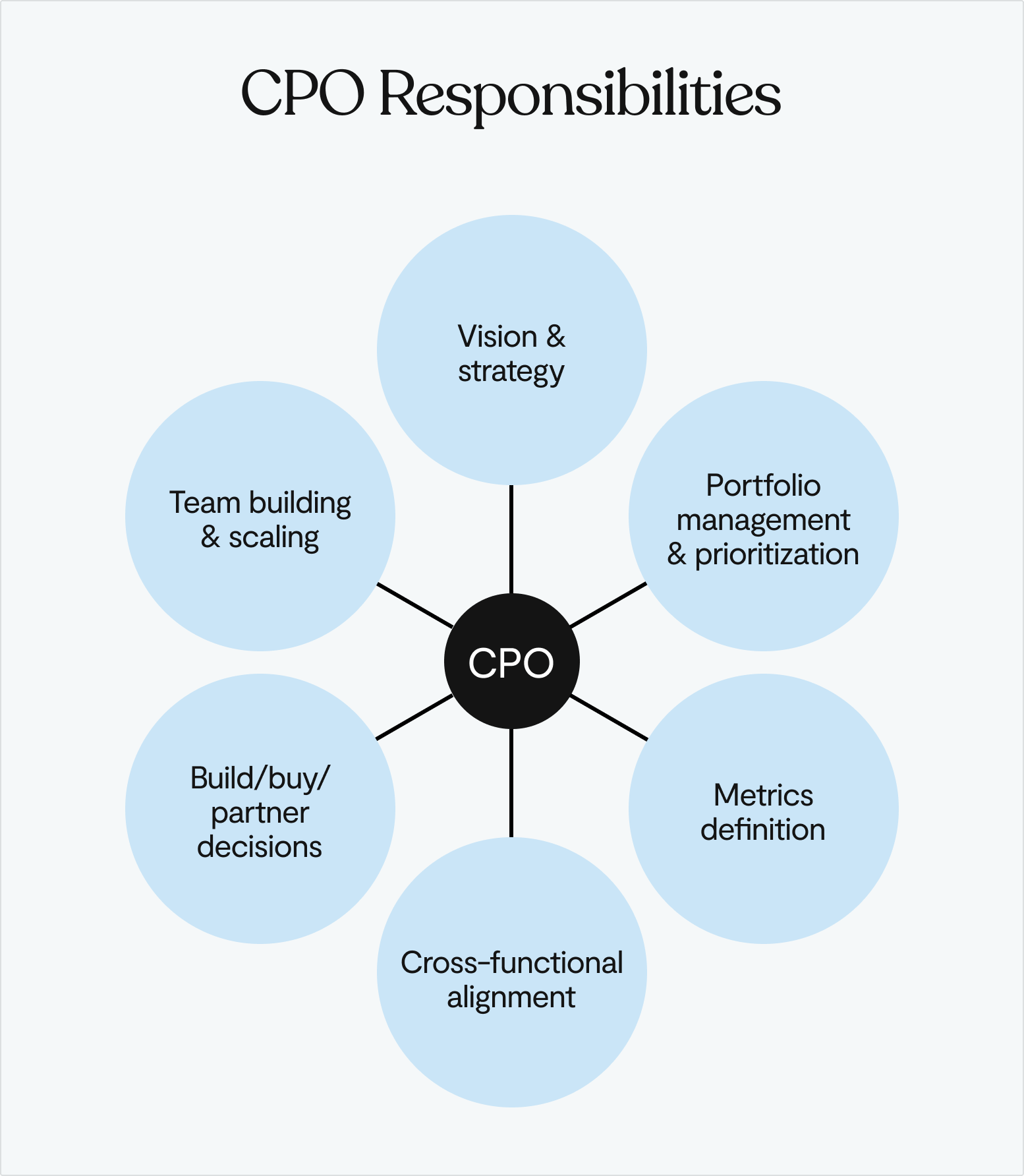
1. Defining product vision and translating it into strategy
A CPO creates the product vision – the "what does this become?" – and translates that into an actionable strategy that the entire organisation can execute against.
It means answering: What problem are we solving? For whom? Why now? What makes our approach differentiated? How does this evolve over the next 3-5 years?
Then they translate that vision into OKRs (Objectives and Key Results) that cascade down to individual teams.
For example, if the company objective is "become the default tool for remote teams," the CPO might set product OKRs like:
- Objective: Deliver seamless async collaboration that replaces meetings
- Key results:
- Increase DAU/MAU ratio from 35% to 50%
- Reduce time-to-first-value from 3 days to 3 hours
- Achieve 40% of teams using async features weekly
2. Managing product portfolios with clear prioritisation frameworks
As you scale, you're no longer managing one product, you're managing a portfolio.
The CPO uses frameworks to make trade-offs between competing priorities. They make sure you're not over-investing in indifferent features while neglecting basics.
3. Establishing the important metrics
A CPO defines which metrics indicate product health and business progress. This is harder than it sounds because the wrong metrics drive the wrong behaviour.
➡️ For pre-PMF companies, focus on learning metrics:
- Week-1 retention (do users come back?)
- Time to first value (how fast do they get their aha moment?)
- Core action completion rate (are they doing the thing?)
➡️ For growth-stage companies, shift to business metrics:
- Activation rate: % of signups that complete core actions
- Product-qualified accounts (PQAs): High-intent users showing buying signals
- Net dollar retention: Revenue expansion minus churn
- Feature adoption: % of users engaging with key features
The CPO's job is picking the right metrics. For example, optimising for DAU (daily active users) might drive wrong behaviours if your product should be used weekly. A fitness app wants daily use; an accounting SaaS might only need monthly use.
4. Building cross-functional alignment through shared goals
Product doesn't exist in a vacuum. The CPO collaborates with every function to make sure product decisions support business objectives:
- With sales: Understanding enterprise customer needs without building one-off features that don't scale. Creating product-qualified lead (PQL) scoring systems so sales focuses on high-intent users.
- With marketing: Defining messaging that accurately reflects product capabilities. Coordinating product launches and feature releases.
- With customer success: Understanding why customers churn and which features drive retention. Building onboarding flows that CS can scale.
- With engineering: Making build/buy/partner decisions. Balancing technical debt against feature development. Setting realistic timelines.
- With finance: Connecting product investments to revenue outcomes. Justifying R&D spend with data on customer lifetime value and acquisition costs.
5. Making build/buy/partner decisions
Should you build the feature in-house, buy a company that has it, or partner with someone who offers it?
Great CPOs assess these trade-offs strategically. Rubrik's CPO, for instance, realised their strength was on-premise data management, but they needed cloud capabilities to achieve their vision. Rather than spend 2-3 years building cloud infrastructure, they acquired a company with complementary DNA and accelerated their roadmap by 18+ months.
These decisions require understanding both product strategy and financial implications – exactly the kind of strategic thinking that justifies the CPO role.
6. Building and scaling product teams
As the organisation grows, the CPO is responsible for:
- Hiring diverse product talent across different specialisations (growth PMs, platform PMs, data PMs, technical PMs)
- Creating clear career paths and progression frameworks
- Establishing product team rituals (sprint planning, retrospectives, roadmap reviews)
- Building product operations capabilities (tools, processes, templates)
- Encouraging a culture of user-centricity, experimentation, and outcome-focus
Ultimately, a strong CPO builds the machine that builds products.
5 CPO hiring mistakes, and how to avoid them
Most CPO searches last months and end with someone leaving within two years. That's a catastrophic waste of time and money. Here are the traps founders fall into:
Mistake #1: Hiring too senior, too early
You're Series A, you have 15 people, and you hire a VP who managed 200+ people at a Fortune 500 company.
❌ That person is used to leading through layers of management. They'll spend six months trying to "set strategy" while your team needs someone who can actually prioritise the backlog and ship features.
✅ For Series A/B companies, hire a Head of Product or Director-level person who can grow into the VP/CPO role. Look for someone who's done the job you need at the stage you need it. Someone who's taken a product from 10 to 100 customers, not 1000 to 10,000.
Mistake #2: Hiring for industry experience over product fundamentals
"We need someone who knows fintech," so you hire someone from a big bank who's never actually built a product from scratch.
❌ Product leadership transcends industries. The frameworks for prioritisation, the discipline of user research, the ability to translate business objectives into product strategy – these are universal. Industry knowledge you can teach; product discipline you can't.
✅ Hire for product fundamentals first, industry second. Look for candidates who've demonstrated an ability to:
- Ship products that users love (check NPS, retention, reviews)
- Make data-driven decisions (ask for examples of A/B tests they've run)
- Navigate ambiguity (ask about times they had to kill a feature or pivot strategy)
Mistake #3: Promoting your best PM by default
Your senior PM is crushing it, so you promote them to Head of Product without considering whether they can lead.
❌ Being great at product management is different from being great at leading product managers. The skills don't transfer automatically. Your star IC might struggle with delegation, strategic thinking, or managing up to executives.
✅ Be honest about what you need. If you need a builder who can scale into leadership, promote your PM and give them coaching. If you need strategic leadership now, hire externally and keep your PM focused on execution.
Mistake #4: Hiring before you're clear on what you need
Your board says "you need a CPO," so you start interviewing without defining what success looks like.
❌ Different startups at different stages need different things. A post-PMF company expanding into enterprise needs different skills than a pre-PMF company still iterating on core features.
✅ Before you start the search, answer these questions with your leadership team:
- What will the CPO do that we can't do now?
- What decisions will they own vs. the CEO/CTO?
- What does success look like in 6/12/18 months?
- What's our biggest product challenge, and does this hire solve it?
Create a clear "mission of command" (MOC): Define what the CPO will own, what they'll collaborate on, and what's still CEO territory. For example:
- CPO owns: Product roadmap, prioritisation, team hiring, cross-functional alignment
- CEO owns: Company vision, fundraising, major partnerships
- Collaborate on: OKRs, budget allocation, major product pivots
Mistake #5: Overlooking cultural and founder fit
You hire someone brilliant who worked at Google/Meta/Stripe but fundamentally disagrees with how you want to build the company.
❌ If the CEO has strong product opinions, you need a CPO who can translate vision into execution, not someone who wants to own vision. Conversely, if the CEO is GTM-focused and needs someone to drive product strategy independently, you need a visionary CPO.
✅ Be completely honest about your own strengths and gaps. Ask candidates:
- "Tell me about the best CEO/founder you've worked with. What made that relationship work?"
- "How do you handle disagreement when the CEO wants to build something you think is wrong?"
- "What's your preferred level of CEO involvement in product decisions?"
Fantastic founder-CPO relationships have clear delineation: the founder sets the destination, the CPO charts the course.
When should you actually hire a CPO?
Not every startup needs a CPO from day one. In fact, most shouldn't hire one too early. Here are the specific signals that it's time:
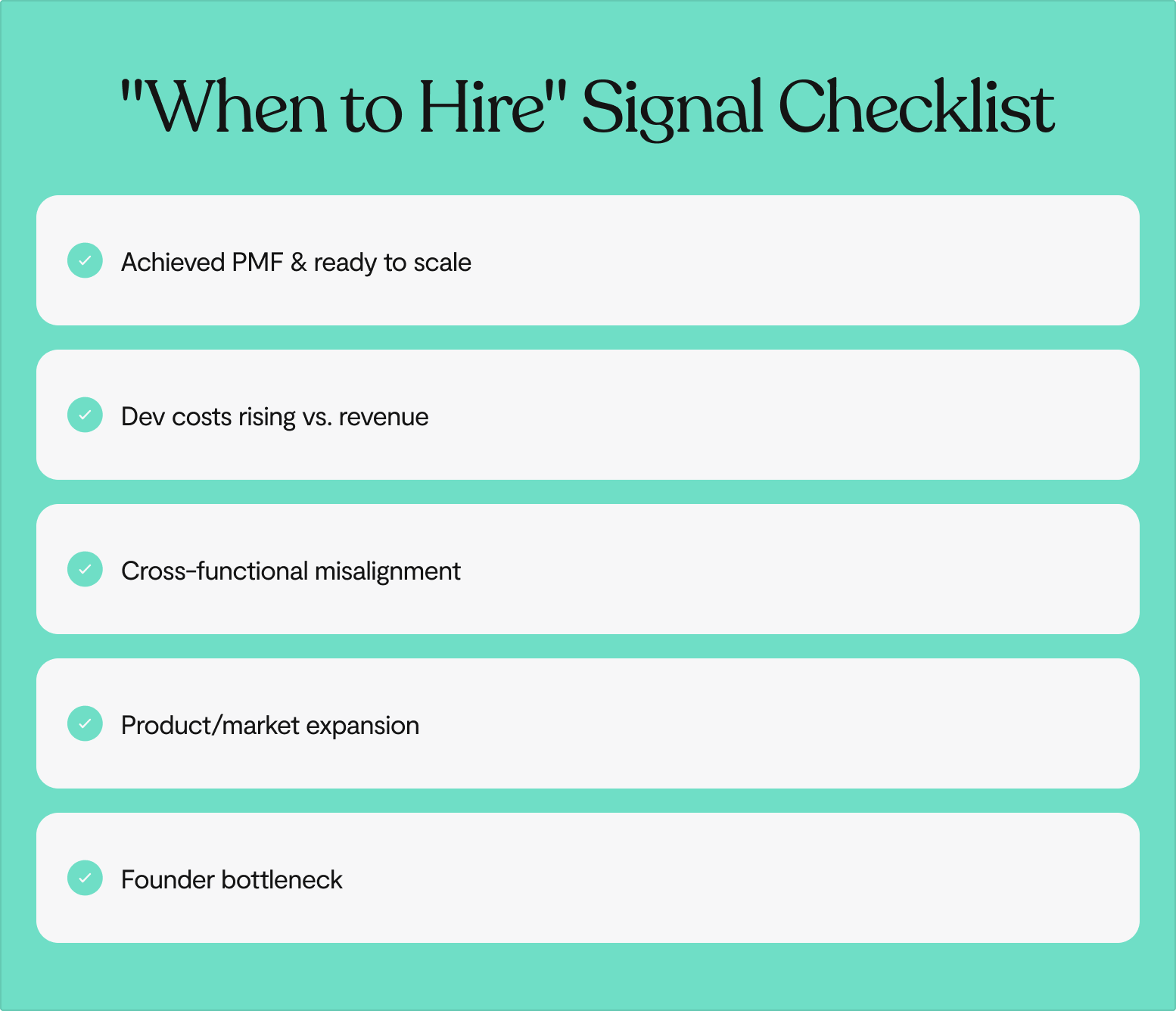
🕜 You've achieved product-market fit and are ready to scale
PMF means you have repeatable evidence that your product solves a real problem. Users stick around, revenue is growing, and you're confident in the direction.
What this looks like:
- Retention curves have flattened (not dropping to zero)
- 40%+ of survey respondents would be "very disappointed" if your product went away
- You're spending more time on scale problems than product discovery problems
🕜 Development costs are rising without corresponding revenue growth
If you've added 10 engineers in the last year but revenue growth hasn't accelerated proportionally, you have a prioritisation problem.
Red flags to look out for:
- Engineering is busy but building the wrong things
- Features ship but adoption is low
- Customer requests dominate the roadmap with no strategic vision
A CPO brings discipline to resource allocation and connects product investments to business outcomes.
🕜 Cross-functional teams aren't aligned on product vision
Your symptoms:
- Product and sales have contradictory priorities
- Engineering builds features customers don't want
- Design feels disconnected from business objectives
- Customer success is fighting fires instead of driving adoption
What's actually happening: You have multiple "mini-visions" across teams instead of one coherent product strategy. A CPO creates unified goals that everyone works towards.
🕜 You're expanding beyond your initial product or market
Moving from one product to multiple products, or from one customer segment to another (SMB to enterprise, domestic to international), dramatically increases complexity.
Different products and segments need different strategies, different messaging, different pricing. Without senior product leadership, these efforts become fragmented.
A CPO manages the entire portfolio with clear trade-offs about resource allocation.
🕜 You're a founder who needs to let go
If you're still making every product decision, you're the bottleneck. The company can't scale beyond your personal capacity to think through every feature and priority.
Honesty is key here: Do you want someone to execute your vision, or do you need someone to own product strategy? The answer determines whether you hire a Head of Product (executor) or a CPO (strategist).
Full-time CPO vs. fractional: What's right for you?
Not every early-stage startup needs a full-time CPO immediately. Here's how to decide:
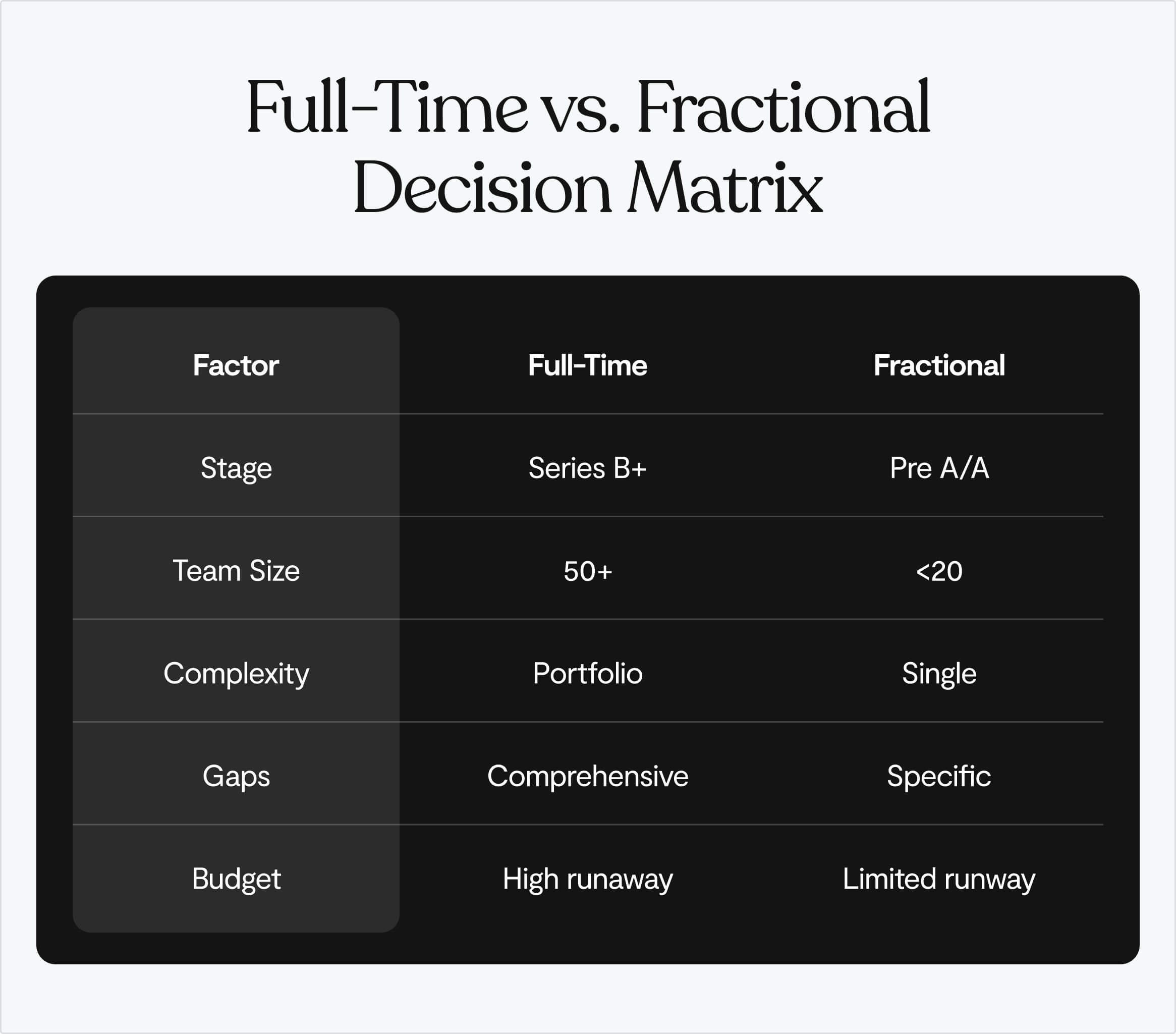
When fractional makes sense:
✔️ You're pre-Series A and need strategic guidance but can't afford (or don't need) a full-time executive.
✔️ You have specific gaps like "we need help with product discovery" or "we need someone to build our product operations" but don't need full-time leadership.
✔️ You're testing the waters and want to see if product leadership makes a difference before committing to a full hire.
When full-time makes sense:
✔️ You're Series A+ with 20+ employees and product complexity requires dedicated leadership.
✔️ You're expanding into new products, markets, or customer segments.
✔️ You need someone who lives and breathes your product because the market is competitive and execution speed matters.
The transition path:
Many successful companies start with a fractional CPO or Head of Product who grows into the full-time CPO role. This lets you:
- Validate fit before making a large commitment
- Give someone the opportunity to grow into the role
- Build the product function progressively as you scale
The role should evolve with the company. Your Series A Head of Product should not look like your Series C CPO. The skills needed change as you scale.
The bottom line: product leadership is a force multiplier
A great CPO enables a host of positive changes:
Strategic clarity: Everyone knows what you're building and why. Priorities are clear. Trade-offs are transparent.
Cross-functional alignment: Product, engineering, design, sales, marketing, and customer success work towards shared goals instead of competing priorities.
Data-driven decision-making: Product decisions are based on evidence, not opinions or the loudest voice in the room.
Faster execution: With clear strategy and empowered teams, you ship faster and with more confidence.
Better outcomes: You build what customers need, not just what they ask for. You measure success by impact, not output.
If you're at the stage where:
- Product decisions are becoming more complex
- You're ready to scale beyond your initial market
- You're spending too much time on product strategy instead of running the business
- Cross-functional teams have conflicting priorities
- Your development costs are rising faster than revenue
...it's probably time to have a serious conversation about hiring a CPO. 🙌
Thinking through your product strategy or wondering if a CPO makes sense for your startup? Let's talk.