


If you're running a startup, you care about building something people actually want before you run out of money.
And the relationship between product strategy and product design – how tightly those two functions talk to each other, or don't – is one of the most underappreciated levers you have for getting there.
Your startup doesn't need a product manager and a product designer. It needs PM-thinking and design-thinking in the same room.
Here's why. ⬇️
Product design vs product management
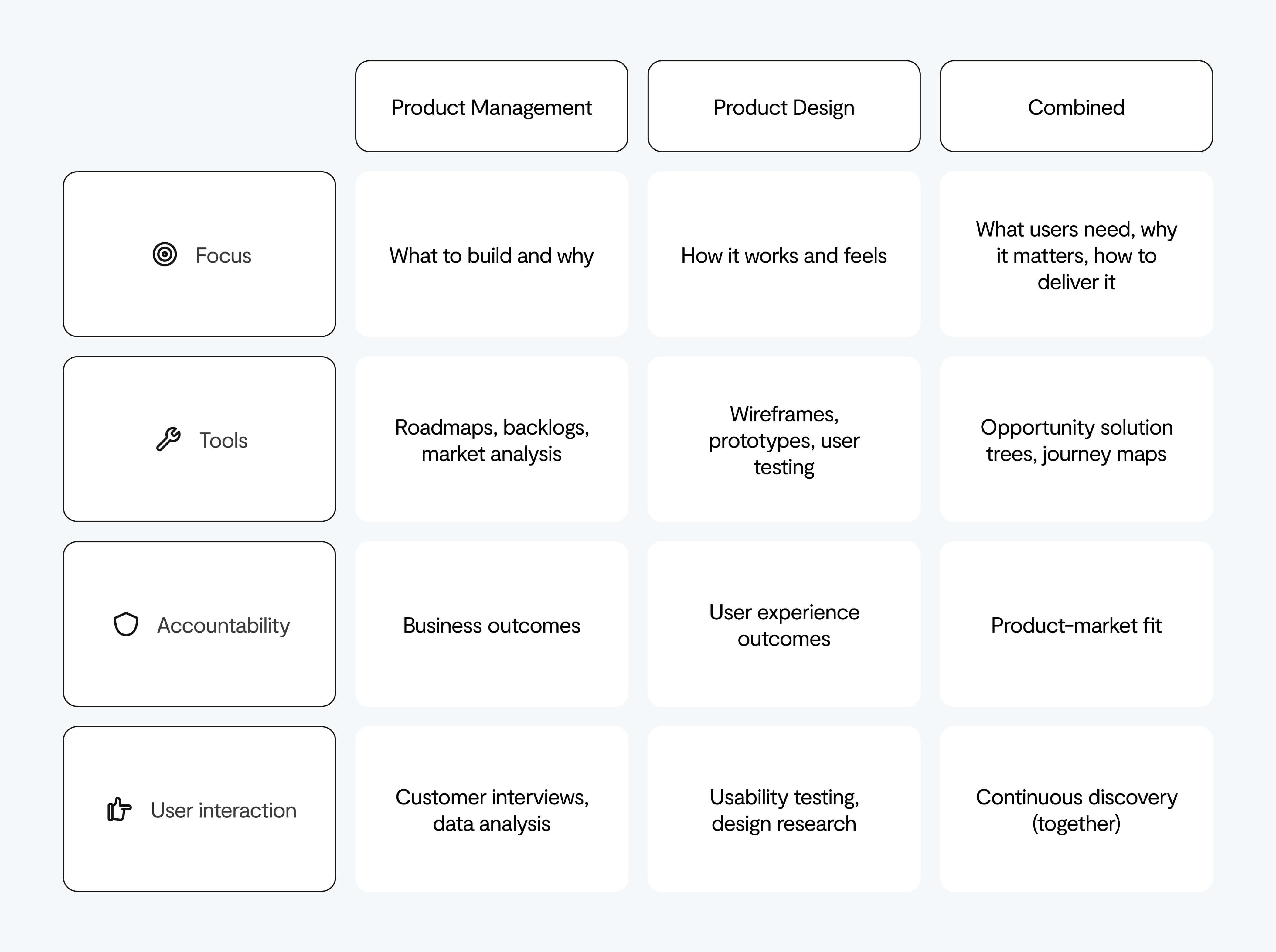
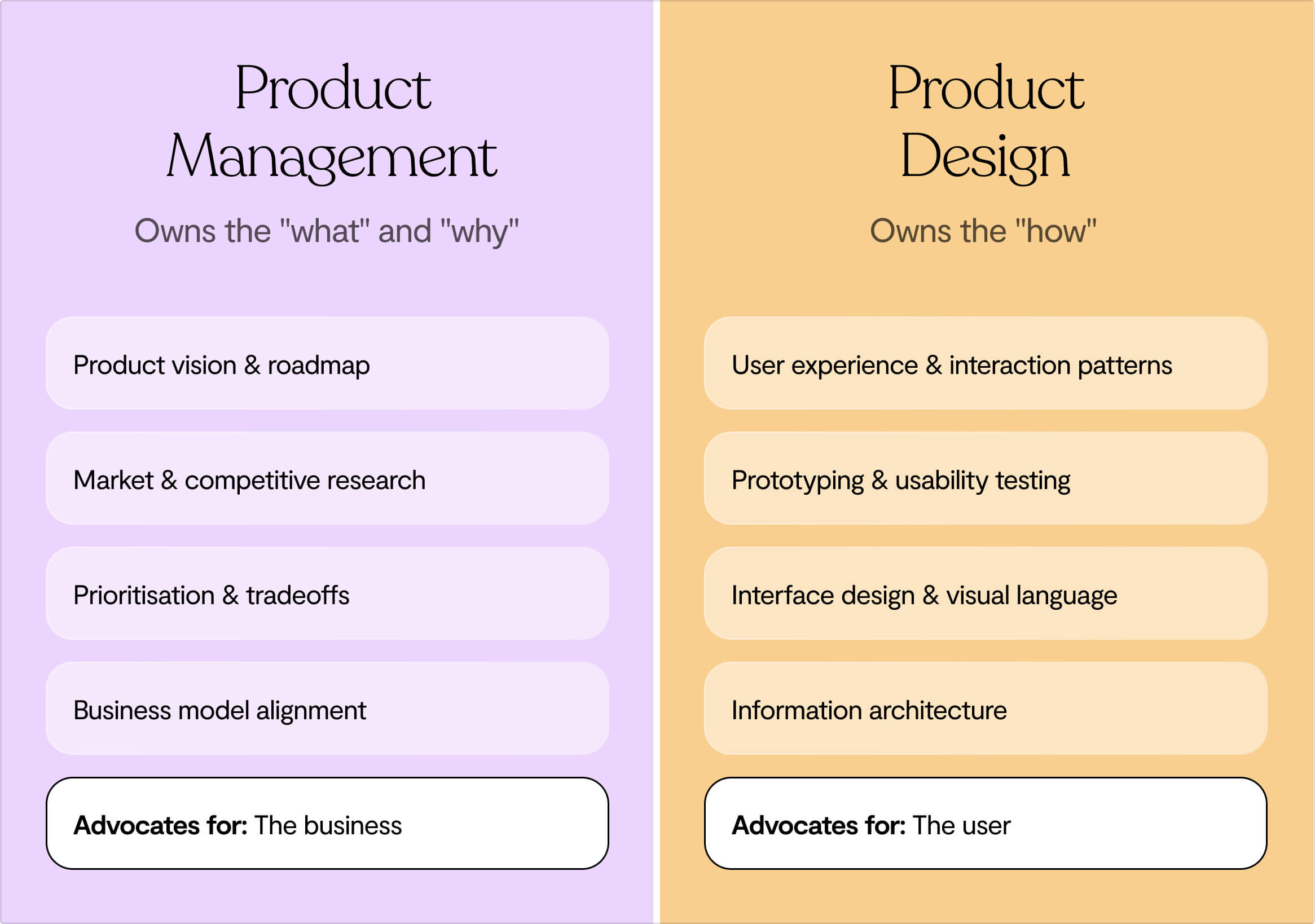
Product management is the "what" and "why." What should we build? Why does it matter to the business and to our users? PMs own the product vision, the roadmap, market research, competitive analysis, and prioritisation. They sit between business goals, market needs, and the internal team.
Product design is the "how." How should this work? How should it feel? Designers own user experience, interface design, interaction patterns, prototyping, and usability testing. They're responsible for making the product worth using.
Another way to think about it: designers are user advocates, PMs are business advocates. Designers solve problems. PMs organise the solving of problems.
But these boundaries blur heavily in practice. Both roles involve user research. Both care about the customer. Both participate in ideation. Both influence what gets prioritised. Unlike developers or QA, a designer's expertise is required at every stage of product development, which is exactly why the scope looks PM-like and why people mix the two up.
Why startups get this wrong
There's a persistent hierarchy in startup culture where PM = prestigious strategic role and design = execution. Ben Horowitz called the PM "the CEO of the product" and that phrase stuck. Design gets cast as the discipline that makes things look nice.
Both of these are wrong.
In practice, the PM's day-to-day is a lot of meetings, firefighting, prioritising, and roadmapping. It lacks the hands-on product-shaping work many people think the role involves.
Meanwhile, designers at companies with strong product cultures absolutely have a seat at the strategy table – doing prioritisation, running team meetings, making real decisions about product direction.
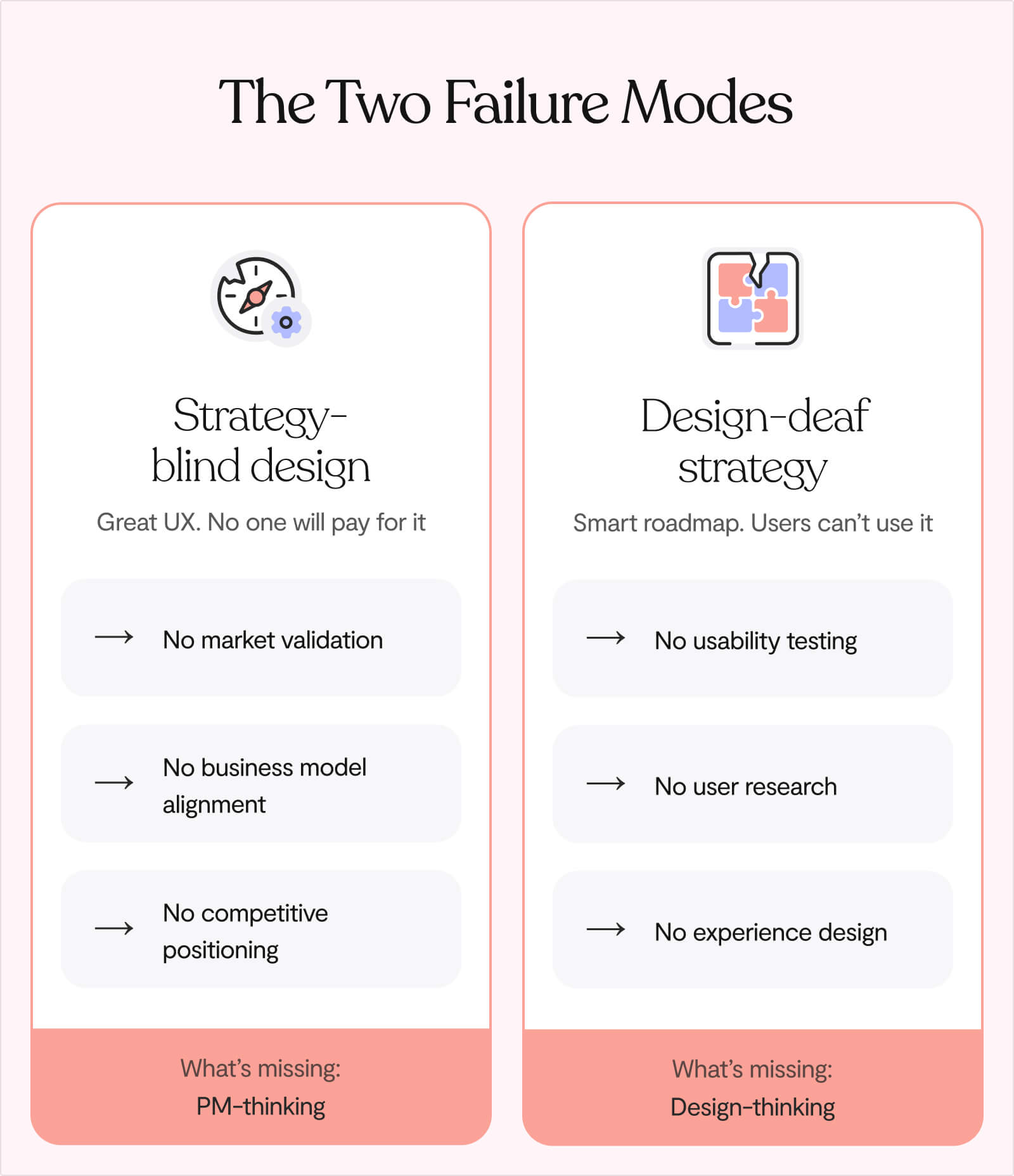
What goes wrong is one of two failure modes:
⚠️ Strategy-blind design. The startup hires designers (or outsources design) but has no PM function. Design decisions happen in a vacuum, disconnected from market reality and competitive positioning.
⚠️ Design-deaf strategy. The founder or PM decides what to build without design thinking. Features get shipped based on spreadsheet logic and stakeholder requests. The roadmap makes sense on paper but the product is confusing, forgettable, or both. Users sign up and never come back.
What happens when these two functions are siloed
CB Insights analysed 111+ startup post-mortems and found the top reasons startups fail:
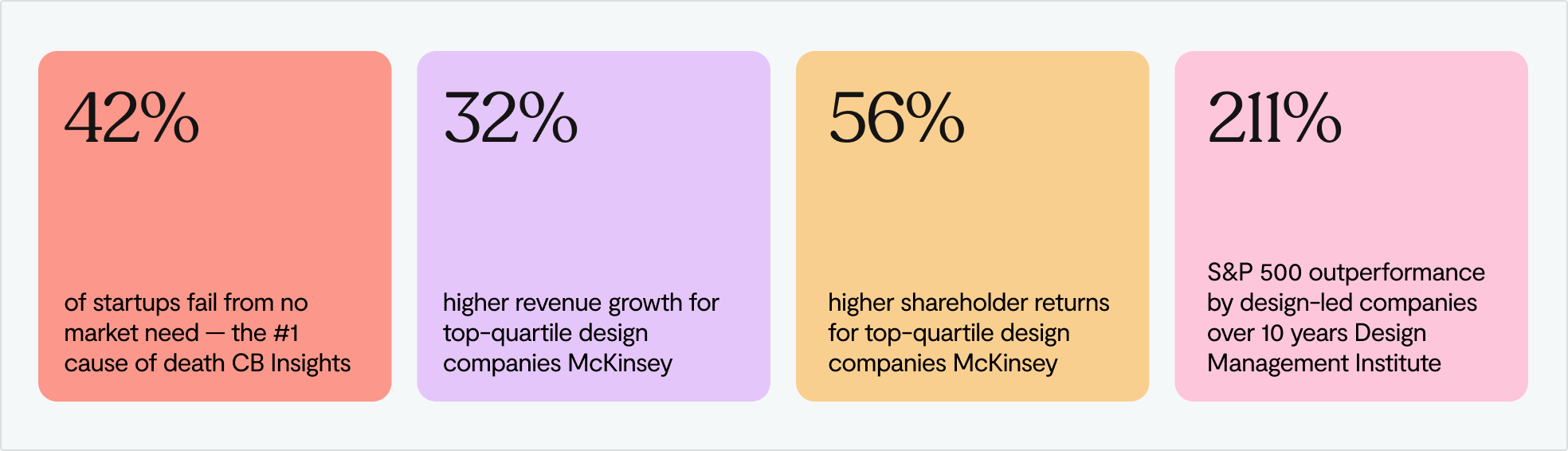
- 42% fail because there's no market need – the single most common cause. This is a product management failure at root: building something nobody wants. But it's also a design discovery failure. If you're not testing prototypes with real users early, you won't catch the problem until it's too late.
- 17% fail because of a poor product – a design execution failure. The thing exists, but it's clunky, confusing, or hard to use.
- 23% fail because they didn't have the right team – which often includes a PM/design mismatch or the absence of one function entirely.
On the other side, companies that invest properly in design see outsized returns. McKinsey tracked 300 publicly listed companies over five years and found that companies in the top quartile for design had 32 percentage points higher revenue growth and 56 percentage points higher total returns to shareholders compared to their industry peers.
The Design Management Institute's Design Value Index found something similar: design-led companies outperformed the S&P 500 by 211% over ten years.
The gold standard: Cagan's product triad
If there's one framework that captures how product design and product management should actually work together, it's Marty Cagan's model from Silicon Valley Product Group.
Cagan builds everything around the concept of empowered product teams: a triad of Product Manager + Product Designer + Tech Lead, working as a genuine unit. Not a PM who writes specs that get lobbed over the wall to a designer, who then throws mockups over a different wall to engineers. A team that discovers and solves problems together.
Empowered teams ⬇️
- Are cross-functional – PM, design, and engineering working simultaneously, not sequentially
- Focus on and get measured by outcomes, not output
- Receive problems to solve, not features to build
Feature teams are the opposite. They get a list of features and basically operate as delivery machines. Without real ownership, or accountability for whether those features actually work.
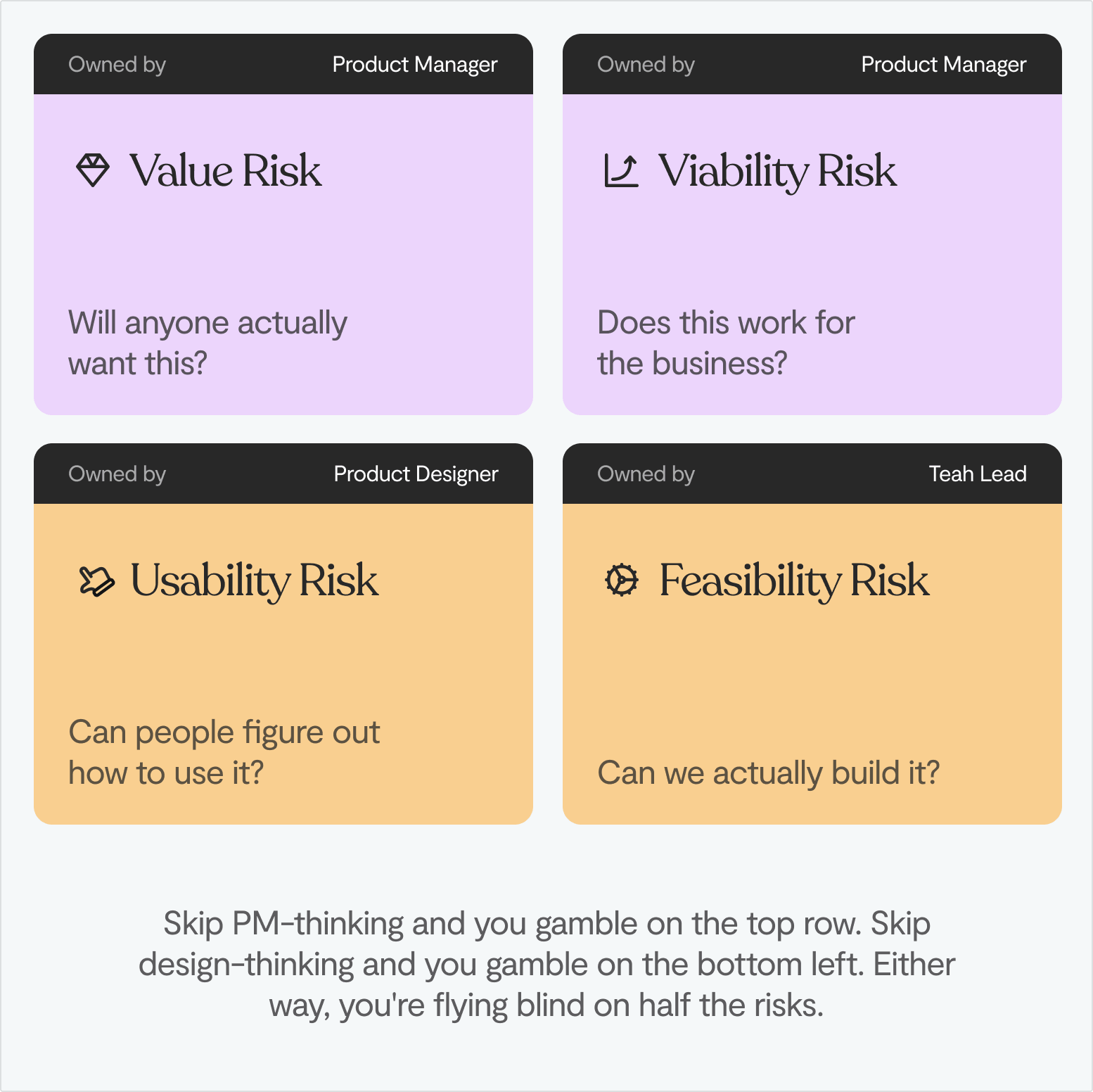
Every product solution, according to SVPG's framework, must address four risks:
If PM-thinking and design-thinking aren't both present during discovery, two out of four risks go unaddressed.
For startups under ~50 people, the CEO essentially fills the Product Leader role. The triad still applies – it's just compressed. The founder needs to be intentional about bringing both strategic (PM) and experiential (design) thinking to every product decision, whether those come from one person or two.
Teresa Torres and the "product trio"
Teresa Torres' Continuous Discovery Habits framework reinforces the same principle from a different angle. She coined the "Product Trio" – Product Manager, Product Designer, and Tech Lead – who should make discovery decisions together from day one.
Her central argument: discovery is a team sport, not a design-only activity.
The trio should talk to customers together weekly. When only one person becomes the "voice of the customer," Torres warns, it becomes a trump card that shuts down cross-functional collaboration. If the designer goes off alone as the user advocate, or the PM disappears into strategy, you lose the shared understanding that produces good product decisions.
The prerequisite mindsets she identifies – outcome-oriented, customer-centric, collaborative, experimental, continuous – aren't PM mindsets or design mindsets. They're product mindsets. They only work when everyone on the team shares them.
The startup reality: you're wearing all the hats anyway
In the early days, everyone does everything. Airbnb's founders Brian Chesky and Joe Gebbia personally designed the website, photographed properties, and answered customer service emails. That's PM work and design work and operations work, all done by the same two people. And it's fine, it's even an advantage. Founders who do everything build the kind of cross-functional pattern recognition you can't get any other way.
But being a product visionary doesn't make you a good product manager. Those are different cognitive modes. Knowing how to make tradeoffs, analyse competing requirements, and structure a roadmap is a distinct skill from design thinking. Many startup founders conflate the two, and the product suffers for it.
Hat-juggling works early on but becomes a bottleneck as the company grows. You know you've hit this wall when:
- Your roadmap is a list of features, not a set of problems to solve
- Design decisions get made based on what the founder likes, not what users need
- Nobody can explain why you're building what you're building
- You're shipping regularly but retention is flat
The answer isn't necessarily hiring a PM and a designer on day one. It's recognising that PM-thinking and design-thinking are two distinct modes that need to coexist from the start – even if one person is doing both.
The rise of the "product creator"
Cagan's more recent thinking takes this further. In his writing with Bob Baxley (former Apple design leader), he argues we're entering the era of the "product creator."
The idea: the real work of a product manager isn't project management, backlog grooming, or requirements gathering. It's product creation – working daily alongside designers and engineers to solve actual problems.
Strong designers, strong engineers, and strong founders can all play the product creator role. It's not tied to anyone's job title. What counts is whether someone is taking responsibility for value and viability (PM-thinking) while someone (possibly the same person) handles usability and experience (design-thinking).
Cagan and Baxley make this especially pointed for the AI era. As generative AI makes execution cheaper, the thinking and judgement that PMs and designers bring becomes more valuable, not less. PMs who merely shuffle tickets and groom backlogs are, in Cagan's framing, "increasingly vulnerable."
Why PLG makes this non-negotiable
If you're building a product-led growth company – where the product drives acquisition, activation, and retention – PM-design alignment isn't a nice-to-have. It's existential.
PLG companies like Slack, Figma, Dropbox, and HubSpot succeed because the product is the marketing. A user's first experience with the product is the entire sales pitch. If they can't see the value quickly, they'll try the next alternative.
“UX sits at the centre of any product-led growth strategy, responsible for creating a customer experience that ultimately determines whether the product succeeds in an increasingly competitive market.”
This is where PM and design have to be in lockstep. The PM defines the "aha moment", what value the user needs to experience. Design makes that moment happen, through onboarding, interface decisions, and interaction patterns that eliminate friction.
When those functions are misaligned in a PLG company, you get one of two outcomes: a product that delivers value but nobody can figure out how to use, or a product that's beautifully intuitive but doesn't connect to anything the user actually needs.
Figma is a good case study here. When Adobe announced its $20 billion acquisition bid in 2022*, the deal valued Figma at roughly 50x its annual recurring revenue – a premium driven by Figma's product-led dominance. Figma had become the default design tool not through enterprise sales motions, but because the product itself solved real designer pain points (PM-thinking) through an experience so good that users pulled their entire teams onto the platform (design-thinking).
*The deal was ultimately terminated in December 2023 due to regulatory concerns, but the valuation says a lot.
The 5 red flags you're keeping them apart

If you're wondering whether your startup has a PM-design alignment problem, here are the warning signs:
1. Designers are treated as a service centre. PMs hand over specs and expect pixel-perfect execution. Designers aren't part of problem framing, just solution delivery.
2. PMs jump straight to solutions. Instead of sharing a problem statement, the PM shows up with "we need a dashboard that shows X." That short-circuits the designer's ability to explore the full solution space.
3. Designers lack business context. They're designing in a vacuum because nobody shared the market data, the competitive landscape, or the business model constraints that should shape their work.
4. Feedback only goes one direction. The PM critiques designs, but the designer never pushes back on strategy or priorities.
5. Scope creep kills quality. PMs or stakeholders keep adding features late in the process, breaking the designer's workflow and compromising the end result.
A designer's perspective helps reframe problems to make them more tractable, and their ability to make ideas visual helps build alignment across a team. When PMs don't take advantage of that, they're leaving a lot on the table.
How to combine forces (even with a tiny team)
You don't need separate PM and design hires to get this right. You need the right thinking applied at the right time.
Share the problem space. Before anyone opens Figma or writes a user story, the team should be aligned on: What problem are we solving? For whom? How do we know it's real? This is where PM-thinking and design-thinking meet.
Do discovery together. Your product trio (or duo, or solo founder) should talk to customers weekly. Not just the PM doing interviews and emailing out notes. Not just the designer running usability tests alone. Together, building a shared understanding of the user's world.
Map the four risks explicitly. For every initiative, ask: Is this valuable? Is it viable for the business? Is it usable? Is it feasible? If you can't answer all four, you've found a gap – and the gap tells you which thinking mode you're missing.
Build shared artefacts. Customer journey maps, opportunity solution trees, and design systems are not PM tools or design tools. They're product tools. The strongest teams build them collaboratively.
Make it structural, not just cultural. It causes problems when product design gets buried under engineering or marketing. Design needs to sit next to product management – organisationally and literally.
What this means for founders working with a design partner
A lot of startups don't have a dedicated PM. The founder fills that role – sometimes well, sometimes stretched so thin it barely gets done.
This is exactly where a strategic design partner changes things. The right design studio doesn't just deliver layouts and interfaces. It brings design-thinking into the product strategy process. It asks hard questions about user needs before anyone starts building. It tests prototypes with real people before engineering time gets committed. It fills the PM gap that many early-stage teams don't even know they have.
At Lumi, we work as a strategic extension of your product team. If you're not sure whether your product problems are strategy problems, design problems, or both, that's usually a good sign it's worth a conversation.