

Why do 90% of your trial signups never come back? It's not because they didn't understand your product.
It's because they never experienced what it actually does for them.
They saw features, read tooltips, maybe even completed your tutorial. Then they left, because knowing how something works isn't the same as feeling why it matters.
This is where a lot of PLG startups break. They've nailed the self-serve signup, built the free tier, removed sales friction. Then they hand users a product tour and activation rates stay stuck at 8%.
Product-led onboarding is about getting them to their first real win before they have time to question whether signing up was worth it.
In this guide, we’re exploring PLG mistakes, different types of onboarding, and exactly how you can nail your PLG onboarding ⬇️
Why PLG onboarding fails so often
Your product has 47 features. You're proud of all of them. So you show users, one tooltip at a time, explaining what each button does and where everything lives.
But users came with a problem, and they need to know if your product can solve it. Showing them dozens of other things first just creates frustration.
According to ProductLed's 2025 PLG benchmarks, 75% of companies begin their product-led growth journey by offering free trials or freemium models, but most waste that opportunity with generic tours. Tutorial completion rates for welcome screens sit at 56% adoption, followed by checklists at 36%, tooltips at 31%.
That means 44% of users skip your welcome screen entirely.
An information overload problem
You ask for too much too soon. Five-field signup forms. Preference questionnaires. Profile completion screens. "Tell us about your company." "What's your use case?" "How did you hear about us?"
Each question is another chance for users to bounce. Freemium products convert about 6% of website visitors to signups, while free trial products convert only 3-4%. Every field you add to your signup form makes these numbers worse.
➡️ Ask for information when you absolutely need it, not when it's good for your CRM.
The tutorial that nobody finishes
Interactive walkthroughs sound good in theory. In practice, most users skip them or abandon halfway through.
Why? Because tutorials teach the interface, not the outcome. Users don't want to learn your UI patterns. They want to accomplish their goal. The UI should be obvious enough that they can figure it out while doing the thing.
The empty state issue
You show users an empty state. Blank dashboard, zero data. A "Get started" button that leads to more emptiness.
New users don't have context yet. They can't imagine what "done" looks like. This is one of the most common and most fatal mistakes in PLG onboarding.
Products now preload sample data, auto-generate starter content, or guide users through interactive onboarding so that by the time they reach the dashboard, something is already there.
Demo data helps set the right expectations, and the longer it takes to collect or add data, the longer it will take for the user to experience value.
How to nail your PLG onboarding
You know what predicts activation better than any framework? These four specific things:
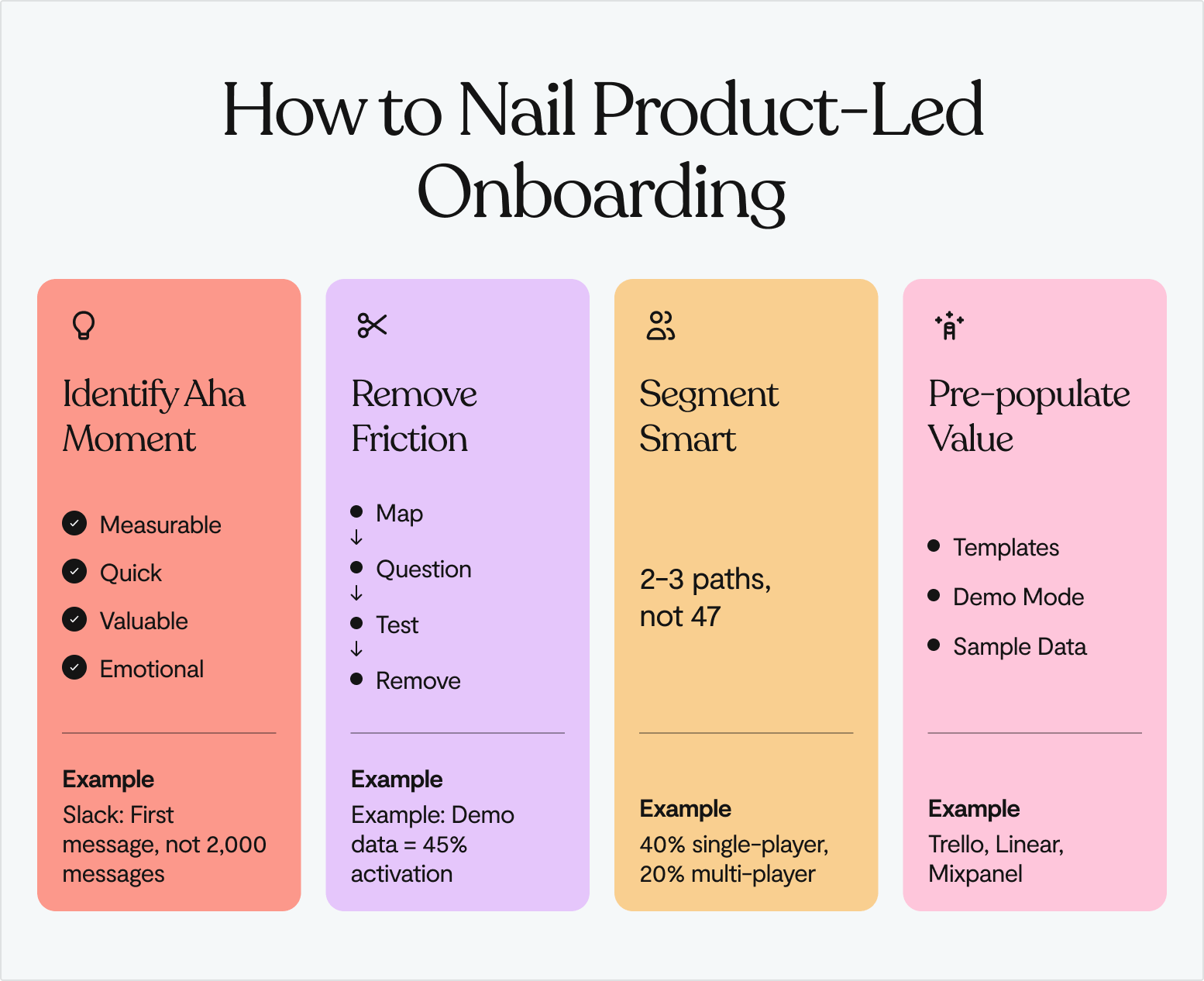
1. Identify your aha moment
This isn't "when users understand the product", it's when they experience real value.
There's a critical distinction here: activation is a business metric that suggests retention, but is not a reflection of the user's experience. Slack's activation metric is 2,000 messages sent, but their aha moment is unrelated to how many thousands of messages users send.
Your aha moment should be:
- Measurable – you can track when it happens
- Achievable quickly – within first session if possible
- Genuinely valuable – not a proxy metric
- Emotionally resonant – users feel the difference
For Canva, users reach value as soon as they create their first design through their frictionless onboarding flow that gets users there within minutes. Calendly's aha moment comes when users sign in with Google to connect their calendar in one step, then seal the deal by prompting users to book a meeting with themselves, relieving any anxiety about sync issues.
💡 How to find it: Look at your retained users. What did they all do in week one that your churned users didn't? Interview both groups. The pattern will emerge.
2. Ruthlessly remove friction between signup and that moment
This is where intentions break down. The roadmap says "reduce friction”, but the actual product adds a progress bar to make the friction feel intentional.
At Snyk for example, activation was defined as F30D: the account Fixed at least one detected vulnerability in the first 30 Days, chosen because it strongly correlated with mid-term retention and monetisation. But getting users there required removing every possible obstacle.
➡️ Map the path from signup to value. Write down every step. Now ask: What happens if we remove this? Test it. You'll find that half your onboarding steps exist because "we've always done it that way" or "marketing wanted that data."
At Keyhole, a social media analytics company, they redid the initial onboarding experience by presenting a dashboard with demo data, increasing their Activation Rate to 45% for the majority of their self-serve users.
💡 The best PLG onboarding is invisible. Users accomplish their goal and only afterward realise they just completed "onboarding."
3. Design for segmentation, not hyper-personalisation
Personalisation sounds great. "We'll customise the experience for each user!" In reality, you'll build dozens of variations that nobody sees because your segmentation logic is broken.
➡️ Start simpler: Identify 2-3 distinct user types. Give each type a path optimised for their goals. That's it.
Products with goal-based segmentation and tailored tours see significantly better results. Average activation varies by product type: single-user products achieve around 40%, multi-user/team products around 20%, and browser extensions around 50%.
Trying to personalise for everyone means personalising for no one.
4. Pre-populate value
Never show users a blank screen.
👀 Trello's empty state onboarding is a Trello project itself, with the far right list labelled "Stuff to try" full of dummy posts that show users how to utilise the product. When you click on cards, Trello outlines actions you can do within the app.
👀 Linear starts users with preloaded issues that act as a checklist but are completely within the product. Users learn by interacting with real-looking data, not by reading about what they could do.
Three approaches work:
- Templates: Miro uses templates categorised by use case to help users get started with boards relevant to them. Horizontal apps used for different vertical use cases benefit most from this.
- Demo mode/sandbox: Mixpanel has a demo sandbox with an introduction and 5 fully set-up analysis boards. This works for products with long or complex onboarding, especially B2B or enterprise tools where setup has significant friction.
- Sample data: Just populate the interface with realistic examples. Use sample data like "Ned Stark" or culturally relevant references that show personality while demonstrating functionality.
5 different types of PLG onboarding models
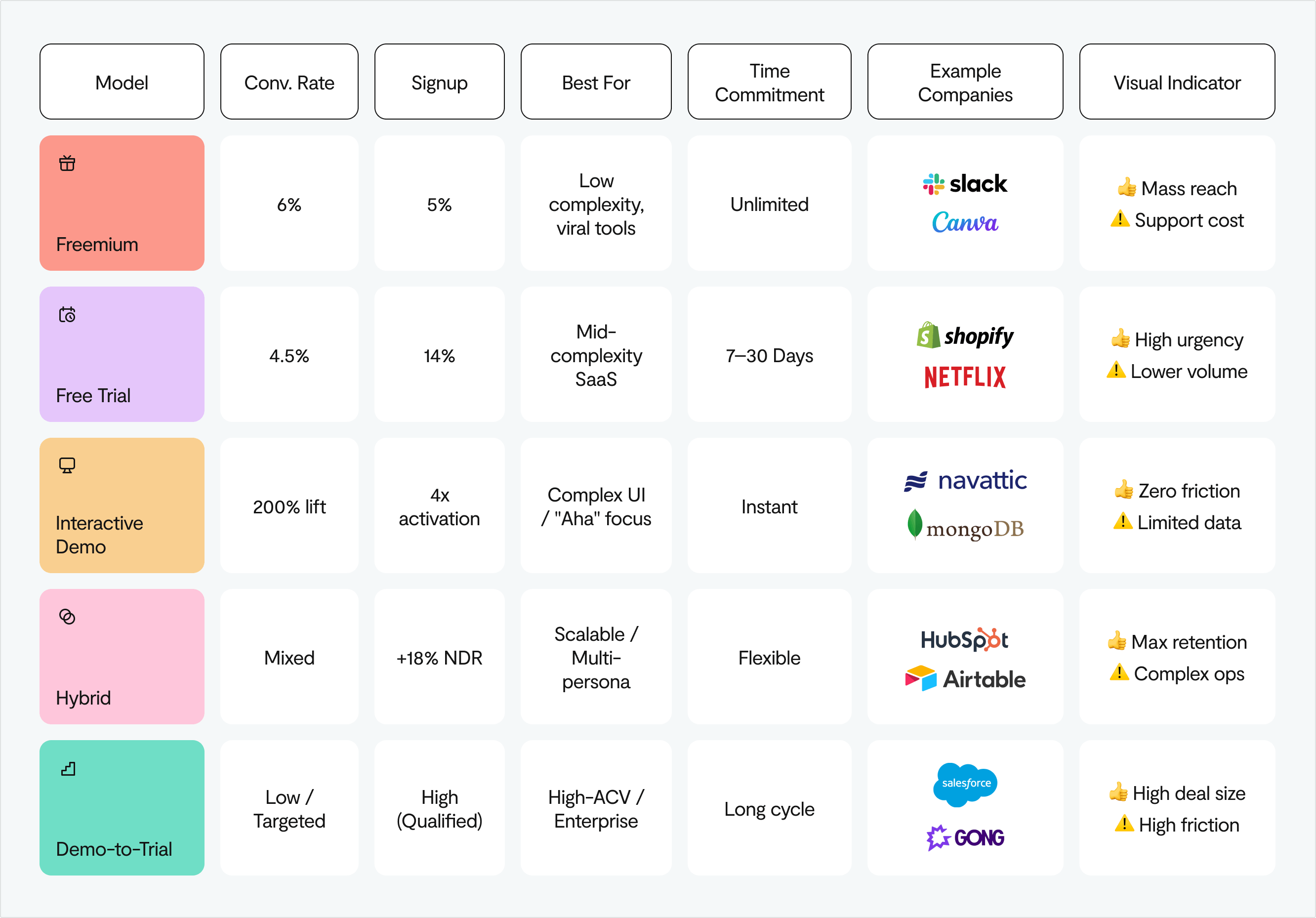
1. Freemium (perpetual free access)
Users get unlimited time with limited features.
Freemium products convert 5% of signups to paid on average. For every 1,000 website visitors, freemium products get approximately 60 signups (6% conversion).
When freemium works:
✔️ Your product has viral mechanics (Slack, Zoom, Calendly)
✔️ Network effects make it more valuable with more users
✔️ Simple products that deliver value immediately
✔️ Crowded markets where you need to remove all friction
2. Free trial (time-limited full access)
Users get complete product access for 7-30 days. Features aren't restricted, time is.
Free trial products convert about 4.5% of website visitors to signups, getting approximately 30-40 signups per 1,000 visitors.
When free trials work:
✔️ Complex products requiring evaluation (Adobe, Salesforce, Shopify)
✔️ High-value software with steep learning curves
✔️ Products where full-feature access demonstrates differentiation
✔️ When you need to create urgency to convert
3. Interactive demo / sandbox (try before signup)
Users explore a pre-configured demo environment without creating an account.
Benchmarks show ungated experiences can boost activation rates by 4x. At Chameleon, adding interactive demos spiked conversions by 200%.
When interactive demos work:
✔️ Products with long or complex onboarding, especially B2B or enterprise products where setup has significant friction, such as infrastructure monitoring products that need integrations and time to gather data
✔️ When immediate value is hard to manufacture
✔️ Products where seeing full functionality matters more than touching real data
✔️ Sales-assist models that need to qualify before giving access
⚠️The aha moment is manufactured, so it doesn't help the user progress down their actual onboarding journey. Users may still need help learning to create content themselves.
4. Hybrid models
It’s sometimes a good idea to combine models for different user segments or stages.
Popular combinations:
Reverse trial: Start users with a free trial, then downgrade to a basic freemium tier after 14 days. Companies like Airtable use this approach, seeing both high first-month conversion and long-tail conversion from engaged free users.
Freemium + premium trial: Notion combines a free personal plan with a 14-day team trial, helping drive 4M+ paid users. Users can stay free forever individually, but get time-limited access to team features.
Feature-specific trials: Mailchimp offers unlimited access to basic features while providing limited-time access to premium features as an onboarding incentive, letting users experience advanced capabilities temporarily.
When hybrid makes sense:
✔️ Different user personas with different needs
✔️ Both viral growth (freemium) and conversion urgency (trial) matter
✔️ You're selling to individuals AND teams
✔️ Some features require evaluation, others are sticky enough for free forever
⚠️ You need separate flows for each path. The upside is worth it, but don't attempt this without solid analytics and experimentation infrastructure.
5. Demo-to-trial (sales-assisted PLG)
Live or automated demo first, then trial access for qualified prospects. Hybrid of traditional sales and PLG.
If your product involves integrations, onboarding support, or configuration steps, dropping users into a trial may lead to confusion. A guided demo sets the stage for success. Enterprise deals rarely involve a single user, multiple stakeholders need to understand different aspects, and a demo helps align them before signup.
When demo-to-trial works:
✔️ Complex enterprise products requiring explanation
✔️ Products with significant implementation requirements
✔️ High-ACV deals where you can't afford low-intent tyre-kickers
✔️ Multiple stakeholders need alignment before evaluation
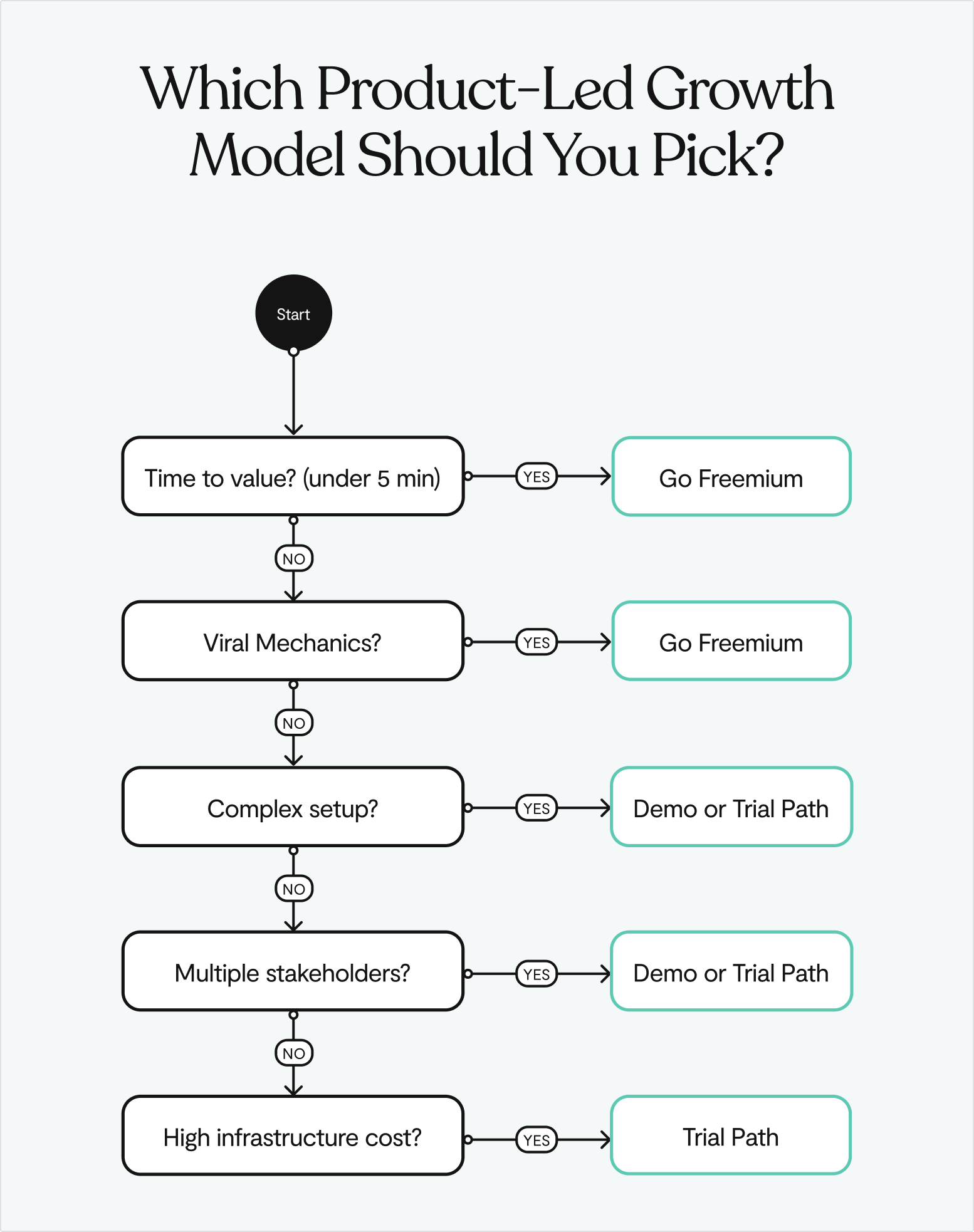
Which PLG onboarding model should you pick?
A common mistake is that startups pick a model based on what competitors do, not what their product needs.
The right choice between a free plan vs trial entirely depends on the nature of your product and market as opposed to your target conversion rate.
Some useful questions to help you make the decision:
- How fast can users experience your core value? (Under 5 min = freemium friendly)
- Does value increase with more users? (Yes = freemium wins)
- What's your competitive landscape? (Red ocean = freemium, blue ocean = trial works)
- Can you support a large free user base? (High infrastructure costs = trial better)
- What's your sales motion? (No sales = pure PLG, some sales = hybrid)
Test your assumptions. When Vidyard struggled with low conversion from a 30-day free trial, they introduced a free Chrome extension in 2017 and saw dramatic improvement. The model you launch with doesn't have to be the model you scale with.
Your onboarding model is a statement about how users experience value, how quickly they need to decide, and whether your product can prove its worth in their hands or needs help explaining itself.
Choose the model that gets users to value fastest, then optimise the hell out of it.
Which PLG onboarding metrics should you track?
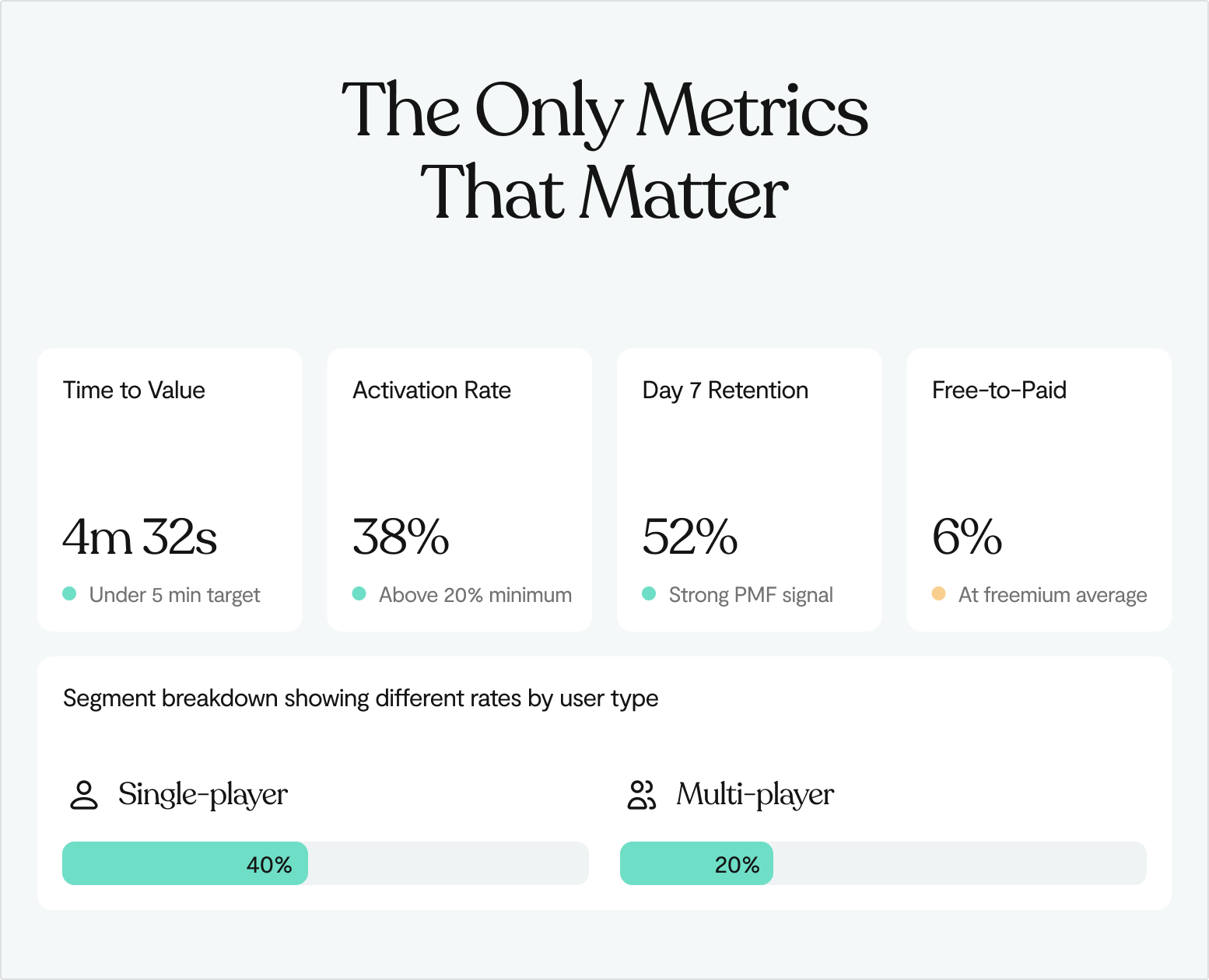
Stop tracking completion rates for your tutorial. Start tracking these:
Time to value (TTV): The share of new users who reach a milestone that proves initial value, such as "created and shared first doc" or "connected data source and saw a chart". The more steps you add in the customer journey, you increase the "time to realise instant value".
Activation rate: Percentage of signups who reach the aha moment. 20-40% activation is good, over 50% is excellent depending on onboarding complexity
Day 7 retention: Do users who hit the aha moment come back? This tells you if your aha moment is actually valuable or just a proxy metric. Early retention is a powerful leading indicator of product-market fit and long-term retention.
Free-to-paid conversion: Freemium products convert 5% of their sign-ups on average, far lower than free-trial products at 17%. Trial-to-paid conversions should achieve 15-30% for enterprise-focused products, while freemium-to-paid typically ranges from 3-5%.
Don't track these in aggregate. Segment by user type, acquisition channel, and experience level. Your onboarding might work great for one segment and terribly for another.
When to bring sales into PLG
PLG doesn't mean zero human touch. It means humans help where they add most value.
High-value customers may want assistance with setup, hands-on training, and addressing challenges they encounter, which can help boost user adoption rates. Enterprise customers with unique needs and use cases may require tailored solutions for effective implementation.
Product does the initial heavy lifting. Humans augment at high-leverage moments. PLG companies that layer in human touch at the right moments see 2-3x higher expansion revenue than pure self-serve.
➡️ Product Qualified Leads (PQLs) are the answer. Track three PQL metrics: number of PQLs over time, PQL rate, and PQL-to-paid conversion, using product triggers like feature adoption and usage caps to qualify without creating MQL-like noise.
Sales teams can add great value when they can offer value-added propositions beneficial to the customer, such as when Sales knows how many employees from an organisation have been using the product and can approach decision-makers with usage data and new manager dashboard features.
Final thoughts
Good PLG onboarding is hard. It requires product thinking, UX craft, data analysis, and constant iteration. Most teams underinvest in it because it's not as exciting as building new features.
But if you're spending $50k/month on acquisition and activating 15% of signups, improving activation to 25% is worth more than doubling your ad spend.
Treat onboarding as a product, not a tour. Measure it, test it, and improve it continuously. Know that getting someone to their first win isn't the end of onboarding, it's the beginning of their product experience.
Good PLG onboarding is hard. It requires product thinking, UX craft, data analysis, and constant iteration. Most teams underinvest in it because it's not as exciting as building new features.
But if you're spending $50k/month on acquisition and activating 15% of signups, improving activation to 25% is worth more than doubling your ad spend.
Treat onboarding as a product, not a tour. Measure it, test it, and improve it continuously. Getting someone to their first win isn't the end of onboarding, it's the beginning of their product experience.
The difference between 15% activation and 50% isn't luck, it's methodology. We help PLG startups identify their real aha moments, remove the friction everyone's too close to see, and build onboarding flows that convert.
Building your onboarding strategy and want a second pair of eyes? Let's talk.