

Are you guilty of thinking of user research like going to the gym?
Something you'll get to once things calm down, once you've raised, once you can afford to do it properly.
So it never happens, and you build on guesswork instead.
But user research can be cheap and easy, so there’s really no reason to avoid it like leg day. 🦵
You don't need a budget, a participant panel, or a research hire. You need five real users and the willingness to hear something you'd rather not.
Here are five free ways to do user research for free ⬇️
Can you do user research for free?
Yes. You don't need a budget, a research team, or expensive software to do user research. You need a handful of real users and the discipline to really listen to them.
The five most effective free user research methods for early-stage startups are:
- Talk to users directly – 1:1 interviews cost nothing but your time
- Guerrilla testing – grab feedback from real people in public or online
- Mine the data you already have – support tickets, analytics, and free session recordings
- Run free surveys – Google Forms and similar tools, used well
- Mine communities and reviews – where your users are already telling you what they want
Research is one half of not building the wrong thing; testing the idea itself is the other.
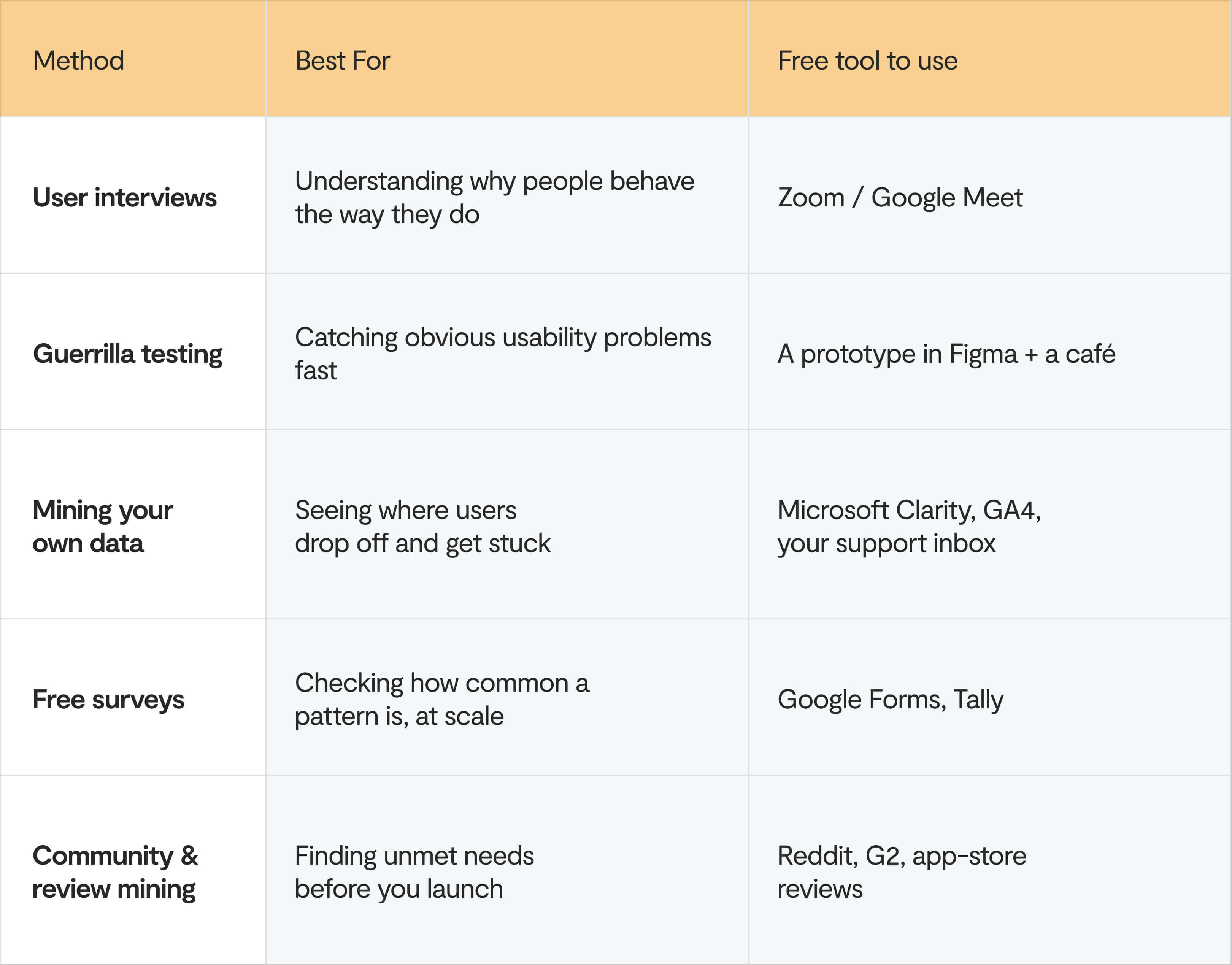
5 free user research methods at a glance
- User interviews: Understanding why people behave the way they do, with Zoom / Google Meet
- Guerrilla testing: Catching obvious usability problems fast, a prototype + a café, or Figma
- Mining your own data: Seeing where users drop off and get stuck, Microsoft Clarity, GA4, your support inbox
- Free surveys: Checking how common a pattern is, at scale, Google Forms, Tally
- Community & review mining: Finding unmet needs before you launch, Reddit, G2, app-store reviews
How much does user research cost?
There’s a misconception that research is expensive, which is a real shame when you realise small, cheap testing works incredibly well.
Why?
Because usability problems tend to cluster. The same handful of issues trip up a big chunk of users who touch your product, so you don't need a big sample to find them. You need a few real people and someone paying attention.
➡️ Testing with just five users surfaces around 85% of a design's usability problems; a single user reveals roughly a third of them on their own. By the fifth person, you're mostly watching the same problems happen again, and that repetition is your cue to stop testing and start fixing.
It also changes how you'd spend a budget if you had one. One big study is the wrong buy. You learn far more from several small rounds of five: test, fix what broke, test again.
So user research can cost zero $$$, just make sure you’re able to:
- Have five conversations, not fifty
- Make them happen now, not after the next raise
- Do it again after you've changed things.
How to do user research with no budget: step by step
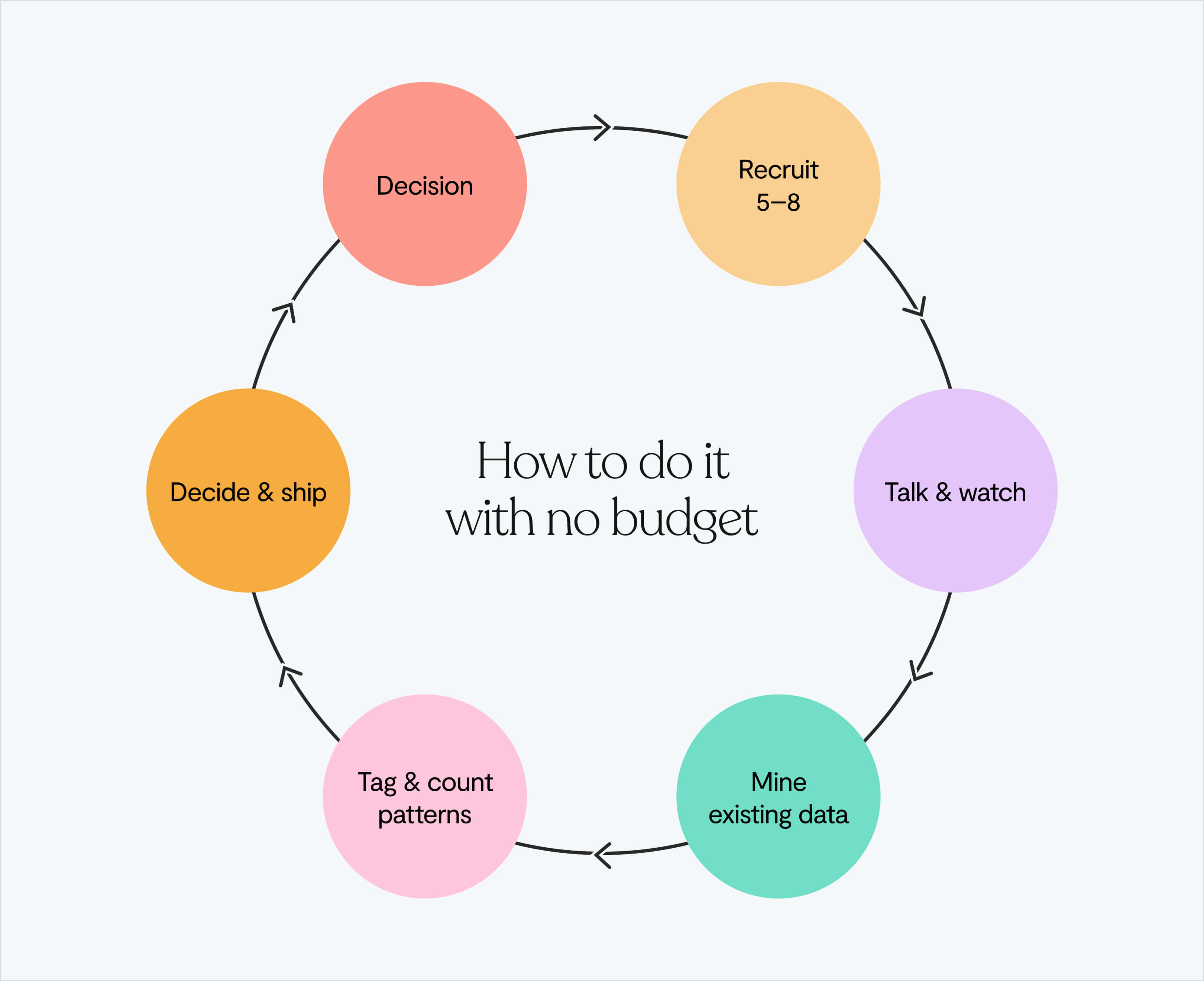
Free research goes wrong when it's aimless: you talk to a few people, nod along, and change nothing. The trick is to run it as a loop with a decision at the centre: ask a specific question, gather just enough to answer it, act, then go round again. Here's how to do it:
- Write down the decision you're trying to make. "Should onboarding ask for a card up front?" is a question. "Let's learn about our users" isn't.
- Pick the users who matter for that decision – the people whose behaviour would change your answer.
- Recruit five to eight of them manually from your waitlist, network, or the communities they already hang out in.
- Talk to them and watch them use your product. Interviews for the why; a quick task for the where it breaks.
- Mine what you already have alongside it: support tickets, analytics, and session recordings you're already sitting on.
- Tag and count the patterns. Anything that comes up three or more times is a real direction to take.
- Make the call, ship the change, and run it again. One round finds the problems; the next round tells you whether your fix worked.
Can you believe all of that costs nothing and takes no longer than a week?
So here’s a deeper look at how to do free user research in the 5 most impactful ways ⬇️
1. Talk to users directly, and guardrail the truth
There’s a crazily high value research method that’s so simple when it comes down to it: actually talk to the people you're building for.
"There are no facts inside the building, so get the heck outside."
Everything you believe about your users is a guess until you've heard it from them.
But be aware that people lie to be nice. Ask a friend, or a polite stranger, whether your idea is good and they'll say yes because they don't want to hurt your feelings. That false "yes" is more dangerous than a "no", because you build on it.
A great fix is The Mom Test by Rob Fitzpatrick; i.e. how to talk to customers "when everyone is lying to you." It comes down to three rules:
- Talk about their life, not your idea. The moment you pitch, they switch into "be encouraging" mode and the data goes bad.
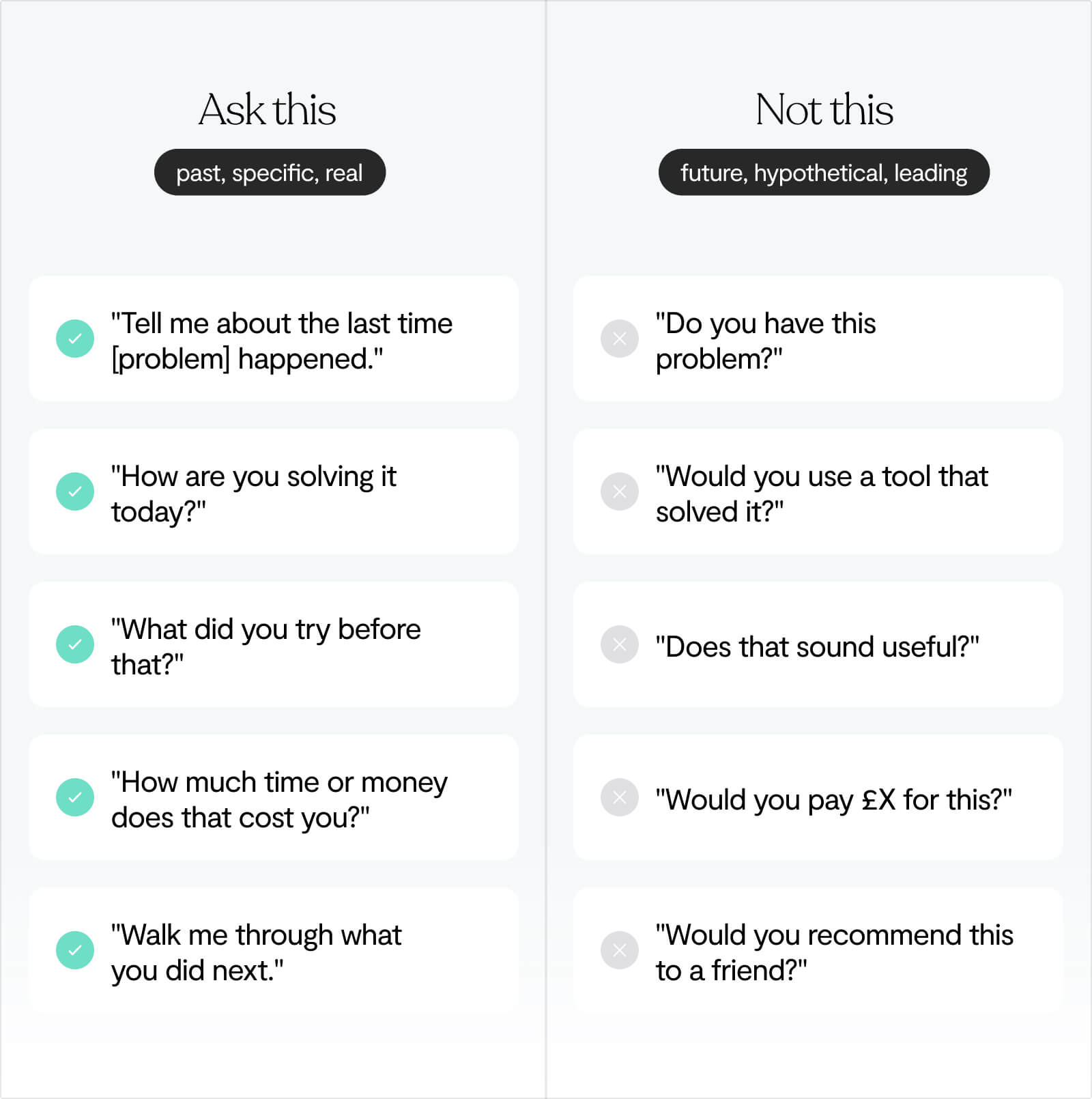
- Ask about specifics in the past, not opinions about the future. "Would you use this?" gets you a lie. "Walk me through the last time this happened" gets you the truth.
- Talk less, listen more. They should be talking 80% of the time. Every "why?" and "tell me more about that" is free gold.
Good questions vs questions that lie to you:
A five-question starter script you can run in fifteen minutes:
- "When did you last run into [the problem]? Tell me what happened."
- "How did you deal with it; walk me through it step by step."
- "What's the most frustrating part of doing it that way?"
- "Have you looked for a better way? What did you try?"
- "If it happened again tomorrow, what would you do?"
Notice not one of them mentions your product. You're collecting facts about their life, not fishing for approval of your idea.
Want the full version? We've written a complete guide to interviewing customers: how to recruit them, what to ask, and how to make sense of what you hear.
A few practical notes:
- Recruit from where your users already are: your waitlist, LinkedIn, relevant subreddits, Slack and Discord communities, your own network. Ten polite DMs usually gets you two or three conversations.
- Aim for five to eight people per round, per user type.
- Record it (with permission) so you can pay attention instead of scribbling.
And do it properly: if you're recording people or storing their answers, you're handling personal data, so tell them what you're collecting, why, and get their consent. The UK government's Service Manual on user research is an excellent free reference on running research ethically and inclusively.
2. Guerrilla testing (fast, scrappy, and free)
What is guerrilla user research?
Guerrilla user research is a fast, low-cost method where you approach people in public spaces (or online) and ask them to give quick feedback on your product or prototype, instead of formally recruiting and scheduling participants. It trades statistical stiffness for speed and cost, which is exactly the trade an early-stage startup would be happy to make, right?
Think of it as the research equivalent of busking. You go where the people are, you ask for a few minutes, you learn something real.
How to do guerrilla testing on a budget:
- Offline: take your prototype to a café, a co-working space, or a library. Buy someone a coffee in exchange for five minutes and one task: "Try to sign up and tell me what you're thinking as you go."
- Online: post your prototype in a relevant community, or share a Figma link and ask three specific questions.
- Give people a task, not a tour. Watching someone fail to complete a task is worth ten people saying "looks nice."
- Watch for the pause. The moment of hesitation is the bug. People rarely tell you they're confused, they just go quiet, squint, or click the wrong thing.
Is it perfectly representative? No. But five scrappy sessions will expose your most embarrassing usability problems in a few hours, and those are the ones costing you sign-ups right now.
3. Mine the data you already have
Before you collect anything new, look at what your product and your inbox are already telling you. This is the cheapest research there is, because the data already exists.
Free user research sources you already own:
- Support tickets and sales chats – every "how do I…?" is a usability problem with a timestamp. Tag them, count them, and your top five friction points fall out on their own.
- On-site search queries – what people type into your search box is a list of things they expected to find and couldn't.
- Analytics – Google Analytics 4 is free and shows you where people drop off.
- Session recordings and heatmaps – this is the big one.
Our personal favourite is Microsoft Clarity. It's free forever, with no limits on traffic, and it's GDPR- and CCPA-ready. You get heatmaps, session recordings, and AI summaries showing exactly where users click, scroll, hesitate, and rage-tap. Watching ten real recordings of people using your site can be more clarifying than a month of internal debate.
Numbers tell you what is happening; recordings and tickets tell you why.
Not sure which numbers are worth watching before you've hit product/market fit? Here's our guide to the analytics metrics that matter pre-PMF.
4. Run free surveys (the right way)
Surveys are the most abused research tool in startup-land: usually because they're used to ask people to predict their own behaviour, which they can't.
Used well, though, they're a free way to add scale to the patterns your interviews uncovered.
Google Forms is free and unlimited; tools like Tally and Typeform have free tiers that are prettier if you need them.
How to write a user research survey:
- Interview first, survey second. Use interviews to learn what to ask; use the survey to find out how common it is.
- Ask about real, recent behaviour, not hypotheticals. ✔️ "How did you solve this last month?" not ❌ "Would you pay for…?"
- Keep it under five questions. Completion rate falls off a cliff after that.
- Favour open questions early on. At this stage you want language and surprises, not tidy percentages.
- One measurement to run: the Sean Ellis product-market-fit question – "How would you feel if you could no longer use this product?" If 40%+ say "very disappointed," you're onto something.
5. Mine communities and reviews
Your users are already telling the internet what they hate about the current options.
If you search any of these topics, you'll notice communities full of real people describing real problems in their own words. They’re a real goldmine for user research.
Where to look:
- Reddit and niche forums – search your problem space and read the complaints, the workarounds, and the "is there anything that does X?" threads.
- Review sites (G2, Capterra, Trustpilot) – read the three-star reviews of your competitors. Five-star reviews are marketing; one-star reviews are rants; three-star reviews are a product roadmap.
- App-store reviews – sorted by "most critical," these are a goldmine of specific, emotional, unmet needs.
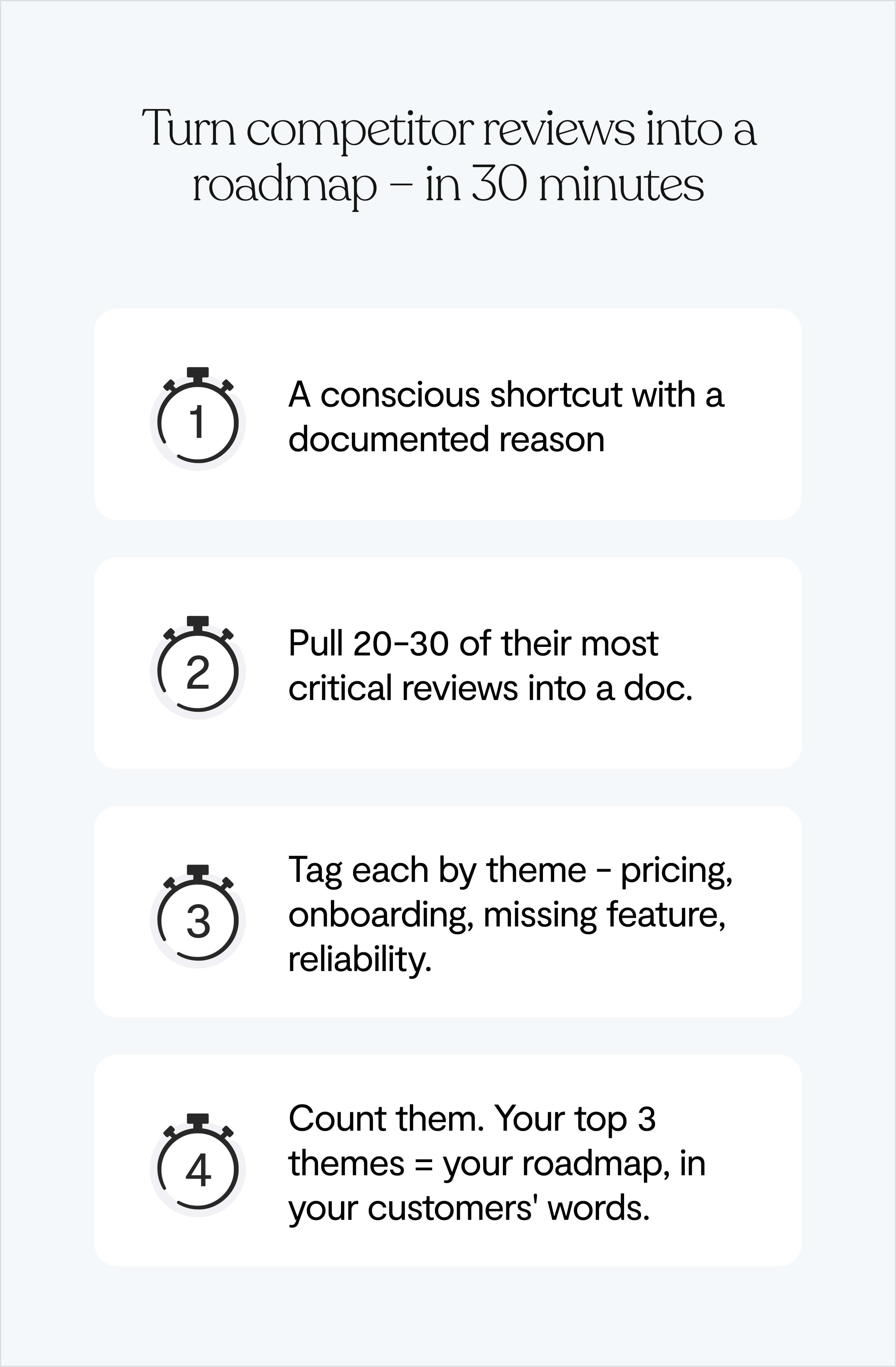
A repeatable 30-minute process:
- Pick your three closest competitors (or the tools people currently cobble together instead of your product).
- Pull 20–30 of their most critical reviews into a doc.
- Tag each one by theme: pricing, onboarding, a missing feature, reliability.
- Count the themes. The top three are your positioning, your roadmap, and your first landing-page headline, written in your customers' own words.
It costs nothing, no one has to say yes to a call, and it works before you've launched.
Where free isn’t enough
Free research is brilliant for direction: what to build, what's broken, what people actually struggle with.
It's weaker on statistical confidence (small samples), on specialist recruitment (hard-to-reach users cost money to reach), and on your own bias: it's difficult to run and interpret research on a product you're emotionally invested in.
So do all five of these first. They'll take you a long way. And when the stakes get high enough (a pricing decision, a full redesign, a make-or-break onboarding flow) that's the point where bringing in outside eyes pays for itself.
When you do hit that point, we've put together a data-driven look at how much a startup should spend on UX, so you're not guessing at the number either.
Frequently asked questions
What is the cheapest way to do user research?
The cheapest useful method for user research is 1:1 user interviews – they cost only your time. Recruit five to eight people from your waitlist, network, or relevant online communities, ask about their recent behaviour rather than their opinions, and listen more than you talk.
How do you do user research on a budget?
Start with a decision you need to make, then use free methods to inform it: interview five to eight users, run guerrilla tests on your prototype, mine your support tickets and analytics, and read competitor reviews. You can complete a full round in about a week for £0.
How do you ask good user research questions?
Ask about real, past behaviour rather than future intentions, and never pitch your idea first; people say yes to be polite. Rob Fitzpatrick's The Mom Test boils it down to three rules: talk about their life not your idea, ask about specifics in the past, and talk less than they do.
How many users do you need to test with?
About five. Nielsen Norman Group's research shows that testing with five users uncovers roughly 85% of usability problems. Rather than one big study, run several small rounds of five and fix issues between them.
What are the main types of user research?
User research splits two ways: qualitative (interviews, usability testing, guerrilla testing) tells you why people behave as they do, while quantitative (surveys, analytics) tells you how many and how often. Early on, lead with qualitative, because you need direction before you need numbers. If you're weighing this against market research, we break down the difference between the two here.
Is guerrilla user research reliable?
It's reliable for finding obvious usability problems quickly and cheaply, but not for producing statistically representative data. Use it to catch the friction that's costing you sign-ups now; use more structured research when you need confidence in a specific number.
What free tools do you need for user research?
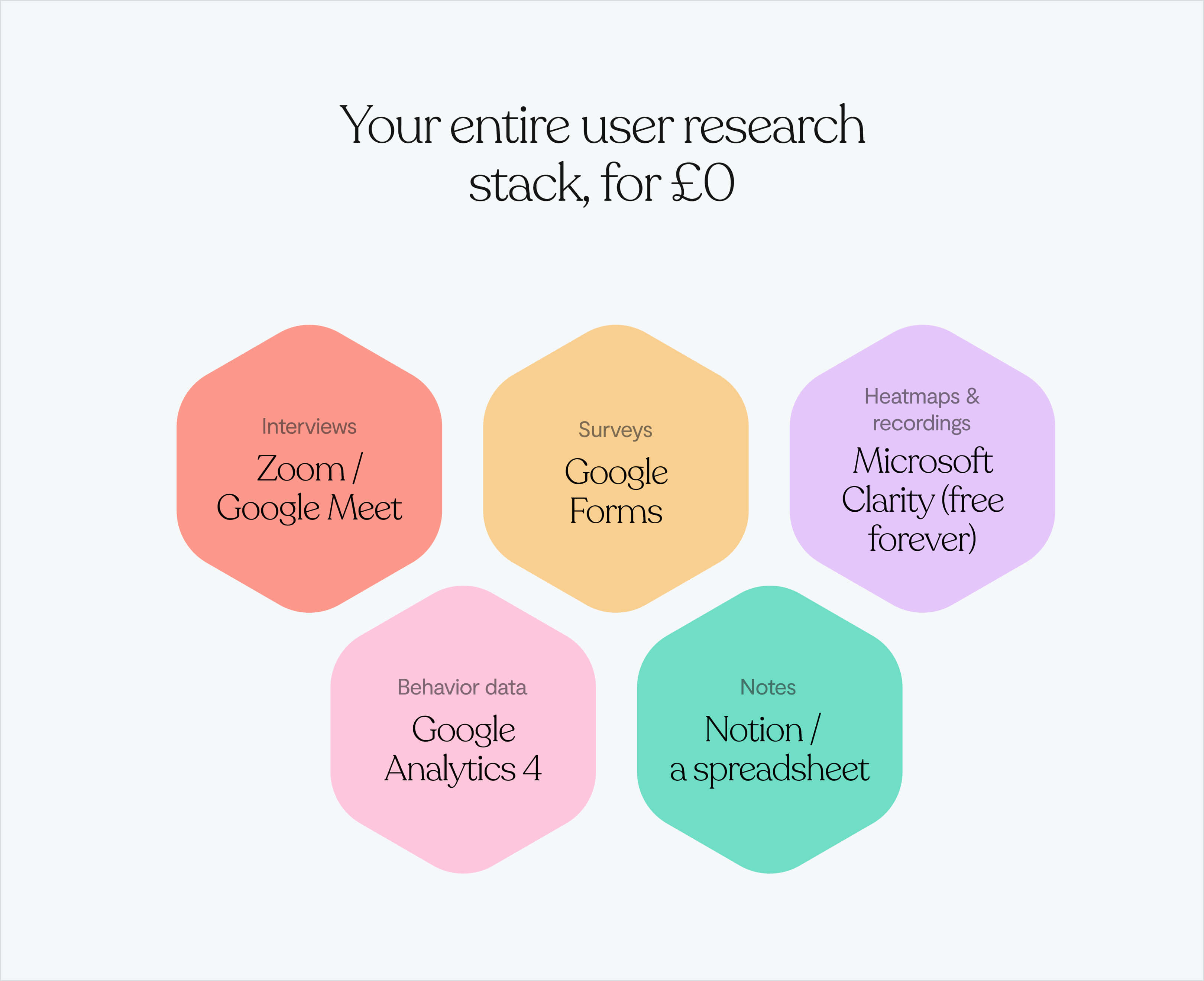
Very few. A video-call tool for interviews, Google Forms for surveys, Microsoft Clarity (free forever) for heatmaps and session recordings, and Google Analytics 4 for behavioural data. Plus a free repository to keep your notes in one place.
When should a startup pay for user research?
When a decision is expensive to get wrong. For example, a major pricing change, a full redesign, or reaching a specialist audience you can't recruit for free. Or when your own closeness to the product is making it hard to judge the findings objectively.